Cotton foliar feeding techniques: master the key points for higher yields
1. Foliar nitrogen spray to prevent premature senescence. When cotton is deficient in nitrogen, the leaves turn pale yellow, the lower leaves wither and yellow, there are few fruit branches, and flowers and bolls are sparse; decline appears at the beginning of boll opening, affecting cotton yield and quality. Spraying method: prepare a 1% urea solution, spray 100 kg per mu, once every 7-10 days, spraying continuously...
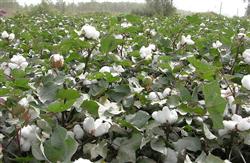
1. Foliar nitrogen spray to prevent premature senescence. When cotton is deficient in nitrogen, the leaves turn pale yellow, the lower leaves wither and yellow, there are few fruit branches, and flowers and bolls are sparse; decline appears at the beginning of boll opening, affecting cotton yield and quality. Spraying method: prepare a 1% urea solution, spray 100 kg per mu, once every 7-10 days, spraying continuously 2-3 times.
2. Foliar boron spray for more boll set. When cotton plants are deficient in boron, the fruit branch nodes are high, there are many side branches, the leaves are thick, and the bracts of the buds tend to open and fall off, causing the consequences of buds without flowers and sparse flowers and bolls. Spraying method: at the peak bud stage, full flowering stage and flowering-boll stage, spray with a 0.2% borax or 0.1% boric acid solution. If 0.3% urea is added to the boron fertilizer solution, better results will be obtained.
3. Foliar phosphorus spray to promote early maturity. Foliar phosphorus spraying can, in the early stage, promote cotton plants to be strong but not excessively vigorous and increase the boll-setting rate, and in the later stage can promote full seeds, increase boll weight, and advance boll opening. For phosphorus spraying on cotton, a 0.2% potassium dihydrogen phosphate or 0.5% calcium superphosphate aqueous solution can be used for spraying, once every 7-10 days, spraying continuously 2-3 times.