Why should cotton topdressing be appropriately advanced?
For seedbeds using nutrient-pot seedling raising, apply decomposed human manure and decomposed organic fertilizer early, and apply compound fertilizer in appropriate amounts. Generally, for a 10 sq m seedbed, apply 0.5-0.7 kg of compound fertilizer with a nitrogen, phosphorus, and potassium content of 45%. Never use urea as the base fertilizer for the seedbed. For the base fertilizer in cotton fields, first increase the application of various organic fertilizers, or...
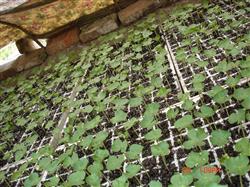 From the initial flowering stage, cotton enters a period of vigorous growth, requiring much fertilizer and absorbing much nitrogen with high intensity. The nitrogen uptake from this point onward accounts for 60% of the total nitrogen uptake during the entire growth period, and the phosphorus and potassium required during this period also account for more than half of the total.
The fertilization principle for high-yield cotton is to do a good job of topdressing management in a timely manner on the basis of base fertilizer. In recent years, the development trend in high-yield cotton cultivation management is to achieve high yield by increasing cotton planting density under the condition of systematic chemical regulation, and this method of creating high yield is especially prominent in the ** cotton region. In addition, in the Yangtze River basin and North China cotton-growing areas, in order to ensure the continuous increase of the total output of cotton and grain crops, there has been a trend in recent years of shortening the cotton growth period and vigorously developing summer-sown cotton. For these two new developments, corresponding new strategies are needed in cotton topdressing management.
In the past, spring-sown cotton was mainly planted, and emphasis was placed on moving topdressing later (mainly nitrogen fertilizer), with the goal of striving for the "three bolls," that is, requiring cotton plants to carry bolls into the dog days, full bolls around the middle, and bolls covering the top in autumn as the characteristics of a high-yield plant type. Therefore, in topdressing, the principle of shifting the focus of fertilization later by heavily applying flowering and boll fertilizer and supplementing top-covering fertilizer was proposed. However, the situation is different now, and the timing of topdressing should be appropriately moved earlier. Under the condition of systematic chemical regulation with mepiquat chloride, applying bud and flowering fertilizer early has a good effect on high yield of spring cotton, such as early enhancement of root vitality. Therefore, the use of chemical regulation technology provides a guarantee for adjusting topdressing time. Topdressing before the cotton field closes can reduce labor and mechanical damage to cotton plants. In particular, for summer-sown cotton or short-season cotton, it is even more necessary to emphasize early topdressing at the bud stage to ensure early development of cotton seedlings and avoid the threat of late maturity. In short, under the premise of adopting systematic chemical regulation, the principle for the whole-process fertilization of cotton is to rely mainly on base fertilizer and to apply topdressing appropriately early. In recent years, high-yield demonstration cotton fields have shown that under the condition of using mepiquat chloride regulation, appropriately advancing topdressing is beneficial to root growth and prevents premature root senescence. Generally, for summer-sown cotton, it is feasible to advance the topdressing period to the bud stage (4-5 leaves) and apply topdressing in combination with hoeing. Topdressing at the initial flowering stage (having already set 1-2 young bolls) is also feasible.
Topdressing at the bud stage or initial flowering stage mainly involves adding an appropriate amount of nitrogen fertilizer (such as 10-15 kg/mu urea). In potassium-deficient soil, where the available potassium content is relatively low (such as strongly sandy light loam), or in cotton fields where potassium fertilizer and organic fertilizer were not applied in the base fertilizer, it is better to additionally apply 5-6 kg of potassium chloride. topdressing potassium at this time can promote increased cotton boll yield. Especially for some plots planted with insect-resistant cotton varieties, the amount of potassium fertilizer must be 30% higher than that for ordinary cotton varieties to meet the needs of high yield.
The application method for topdressing should use mixing fertilizer with soil and timely irrigation. Do not apply urea on the surface, so as to avoid volatilization loss or burning cotton leaves. In production, urea is often scattered on the soil surface while waiting for rain, with neither soil covering nor timely irrigation. This fertilization method is unscientific.
In addition, for high-yield and super-high-yield cotton fields, if growth momentum weakens or self-topping occurs in the late boll stage, 5-8 kg of urea should also be added in a timely manner to prevent premature senescence of cotton plants and strive for autumn bolls.