How to prevent and control dead seedlings in garland chrysanthemum? Soil covering treatment cannot be ignored
Scientific workers at the Shanghai Institute of Organic Chemistry, Chinese Academy of Sciences, isolated a unique antifeedant-active component, chrysanthemum lactone, from the common vegetable garland chrysanthemum (Glebionis coronaria), and for the first time internationally used a new synthetic method to artificially synthesize a batch of chrysanthemum lactone compounds. Tested by South China Agricultural University, an authoritative domestic unit for antifeedant research, this artificial...
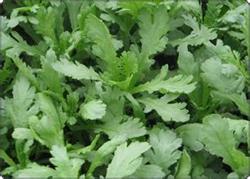 Garland chrysanthemum cultivation mostly adopts the direct seeding method, that is, after preparing the land and applying fertilizer, first irrigate the bed surface once, and after the water infiltrates, mix the seeds with fine soil and broadcast them, and finally cover with soil to cover the seeds.
However, with the increase in planting years in the greenhouse, continuous cropping obstacles have become more and more serious, and root rot and dead seedlings occur commonly. In response, vegetable farmers in Anqiu mostly adopt the measure of chemical soil treatment to prevent it, that is, after irrigating the bed surface once more, they no longer rush to sow, but instead apply carbendazim + thiram with a small amount of water, and after it infiltrates, then sow and cover with soil. We learned that most vegetable farmers using this method achieved good results, but some vegetable farmers still reported that it was not ideal. Later, through our investigation, we found that the problem lay in the soil used to cover the seeds.
The vegetable farmers who achieved good results with this method not only selected covering soil from field plots where garland chrysanthemum had never been planted, but also mixed the soil with agents such as miaojundi. The purpose was to comprehensively prevent miscellaneous bacteria carried by the soil and reduce root rot and dead seedlings. The vegetable farmers for whom this method was not ideal, although they applied fungicides before sowing, neglected the selection and treatment of the covering soil. For convenience, they directly took soil from the original planting plot and, without soil treatment, used it as covering soil for the seeds. As a result, after the garland chrysanthemum seedlings emerged, root rot and dead seedlings gradually occurred.
Here, we suggest that vegetable farmers, when preventing and controlling root diseases of garland chrysanthemum, do not neglect the chemical treatment of the covering soil. Miaojundi can be used to mix and treat the covering soil at a rate of 80-100 grams per cubic meter of soil.