What are the key technical points for selecting sunflower seeds in the field?
I. Selection of the plot, determination of sowing date, sowing rate and density: When planting sunflowers, never practice continuous cropping or intercropping in adjacent strips; the same plot must be left at least 3 years apart. Continuous cropping leads to the occurrence of pests and diseases and an imbalance in soil nutrients, causing severe yield reduction. Soil salt content should not exceed 4500 plants/667 sq m, and follow the rule "sparse planting on fertile land, ...
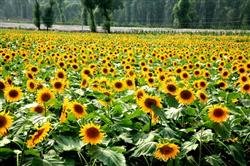 Sunflower is a cross-pollinated crop. In recent years, it has been planted in many places, and some places have paid little attention to field seed selection work, resulting in problems such as mixed and degenerated varieties, poor quality, and decreased oil content, which have a great impact on the yield and quality of sunflower seeds. At present, the sunflowers are about to mature, and doing a good job of field seed selection for sunflowers is very necessary.
According to various experiences, carrying out field seed selection before the sunflower harvest is a simple and effective good method. According to experimental surveys, planting seeds that have undergone field selection increases yield by 20%-25% compared with seeds that have not undergone selection, and the growth and development progress is uniform, with consistent maturity, creating favorable conditions for timely harvest.
I. Field seed selection should grasp four links
1. Determine the excellent variety suitable for local planting, and select plants with the special characteristics of this variety.
2. Select disease-free living plants that have no branching, large heads, plump seeds, and medium height.
3. Select convex and slightly convex heads; heads whose tilt angle with the stalk forms an angle of 45-70 degrees are best. This is because heads with a small tilt angle set seed poorly and are also easily harmed by birds and pathogens, while heads with a large tilt angle, when the seeds mature, are buried in the leaf canopy, are prone to mold, and are inconvenient to harvest.
4. After removing the heads, they must be transported separately, dried separately, threshed separately, and stored separately.
II. Select excellent varieties. Sunflowers are divided into oil sunflowers and confectionery sunflowers. Oil sunflower plants are shorter with small seeds and are mainly used for pressing oil; confectionery sunflower plants are taller with large seeds and are generally used for cracking and eating or as a food additive. For oil sunflowers, it is best to select high-yield, high-oil hybrids, such as "Baikuiza No. 4", "Jikuiza No. 1", "Hungary No. 4", etc. For confectionery sunflowers, "Bai 97-1", "Cun Ke", "Changling Da Ke", etc. can be selected. The advantages of these varieties are disease resistance, very few branches so no pruning is needed, high yield, and good marketability.
III. Seed selection method. In the middle and late stages of sunflower growth, in combination with pruning and artificial supplementary pollination, select plants that have no branching, no pest or disease damage, the same appearance as this variety, consistent plant height and maturity period, and moderate head size, and mark them (also called standing-stalk head-watching selection), and harvest them separately at harvest. Which part of the sunflower is best for seed selection? In a medium-sized (19 cm diameter) sunflower head, there are about 1700 seeds in 28 rings. Which part of the seeds is best used as seed? Experiments by scientific research departments have shown that the fruits in the outer ring of the head have large, plump seeds, but after being used as seed, the resulting plants have underdeveloped root systems, short fibrous roots, few root hairs, low ability to absorb water and fertilizer, are not drought-resistant, and are prone to lodging; although the fruits in the inner ring of the head are numerous, the seeds are thin and small, have a low germination rate when used as seed, and the resulting seedlings are uneven, slender, and weak; the fruits in the middle ring of the head have moderate seeds, neither too large nor too small, plump and full, and high in nutrient content. Using this part of the fruit as seed produces robust seedlings and plants with well-developed root systems, and also a low shell rate and high oil content. It can thus be seen that leaving the fruits from the middle ring of the sunflower head as seed is best.
IV. Timely harvest. About 7 weeks after the full flowering stage of sunflowers, plastic substances no longer increase, physical properties stop changing, and the seed moisture content has dropped to about 30%. From the external morphology, the stalk, the upper leaves of the plant, and the back of the head turn yellow, the ray florets turn yellowish brown, the disc florets fall off, and the shell becomes hard. At this time, the maturity stage has been reached, and it should be harvested in time.
V. Store and keep well. When the seed moisture content has been sun-dried to 8%-9%, store it in bags. In winter, keep the temperature at 3°C-7°C, and in summer the temperature should not exceed 25°C. In this way, within 1-3 years the seed germination rate can be maintained at about 95%. In the fourth year it drops to 85%-95%, while in the fifth year it rapidly drops to 57%-85%. Therefore, the storage period for sunflower seeds generally should not exceed four years.