Occurrence Patterns and Control Methods of Curvularia Leaf Spot in Corn
Corn Curvularia leaf spot, also known as yellow spot disease and called yellow leaf disease by farmers, is another important disease of corn in our province in recent years, following large and small spot diseases and rust. After the onset of Curvularia leaf spot, the leaves are covered with lesions, and when they merge, the leaves dry up and die, seriously affecting corn growth and reducing yield. I. Symptoms: ...
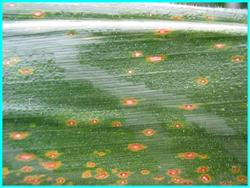
Corn Curvularia leaf spot, also known as yellow spot disease and called yellow leaf disease by farmers, is another important disease of corn in our province in recent years, following large and small spot diseases and rust. After the onset of Curvularia leaf spot, the leaves are covered with lesions, and when they merge, the leaves dry up and die, seriously affecting corn growth and reducing yield.
I. Symptoms: The disease mainly damages corn leaves, and can also damage leaf sheaths and bracts. The lesions initially appear as water-soaked or pale yellow translucent small spots, then expand into round, oval, fusiform or elongated lesions. The lesions vary depending on variety resistance, generally 1-5 mm long and 1-2 mm wide, varying in size; the center of the lesion is pale white and translucent, surrounded by a brown ring, with an obvious yellow halo on the outside; multiple lesions connect to form large spots, and the front half of the leaf or leaf margin necroses; the lesions occur in inconspicuous segmented patterns on the leaf. Under humid conditions, black mold-like substances can be produced, namely the conidiophores and conidia of the pathogen.
II. Pathogen: The pathogens are Curvularia lunata and Curvularia inaequalis, belonging to the genus Curvularia, subphylum Deuteromycotina. The optimum temperature for pathogen growth is 28-32°C, the optimum temperature for conidial germination is 30-32°C, and the optimum humidity is saturated humidity; germination rarely occurs when relative humidity is below 90%.
III. Occurrence patterns: The pathogen overwinters as mycelium latent in diseased residue tissues, and can also overwinter as conidia. Infected corn stalks and weeds are the primary infection sources of the disease; the mycelium produces conidia, which spread to corn leaves via airflow and rainwater for reinfection. Corn Curvularia leaf spot is a typical adult-stage disease; corn has strong disease resistance at the seedling stage, and resistance weakens as the plant grows. Field onset in Henan begins from late July to early August, with the peak occurring after corn tasseling, that is, from mid-to-late August to early September. Because the incubation period of this disease is short (2-3 days), one infection cycle can be completed in 7-10 days. If high temperature and high humidity occur, it can become epidemic over a large area in a short period. Low-lying waterlogged fields and continuous cropping fields have more severe disease.
IV. Control methods: The control strategy for corn Curvularia leaf spot is comprehensive measures based mainly on planting resistant varieties, supplemented by chemical control.
1. Plant resistant varieties. Through resistance identification, the currently more resistant varieties include Nongda 108, Zhengdan 14, Nongda 951, Zhongyu 4, Yedan 12, Zhengdan 7, and Danyu 13; the more severely affected ones include Yedan 13, Danyu 20, and Zhengdan 958.
2. Strengthen cultivation management and reduce overwintering inoculum sources. Practice reasonable crop rotation and reasonable close planting, strengthen management, and improve plant disease resistance; after corn harvest, promptly clean up diseased residues and dispose of them centrally to reduce primary infection sources.
3. Chemical control: At the early stage of disease onset, spray for control when the field disease incidence reaches 10%. Effective agents include Nonglituo, Qingyise, thiophanate-methyl, carbendazim, etc. When climatic conditions are suitable for disease development, apply a second control treatment one week later.