What are the key technical points for sowing and ensuring seedling survival in spring corn?
1. Enrich the seedling bed: Practice seedling raising on a fertile bed. Choose a rapeseed seedling bed or a dry-raised rice seedling pool as the seedling bed for spring corn. Set aside a sufficient seedling bed according to the ratio. For seedling raising with 5 cm pot diameter, the ratio of seedling bed to field area is 1:20; for large-pot seedling raising with a pot diameter above 7 cm, the ratio of seedling bed to field area is 1:10-15. In early...
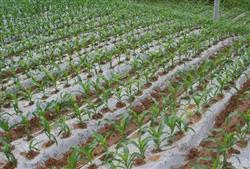 In response to the drought conditions in our province's spring corn production areas, scientifically utilizing effective soil moisture and actively doing a good job in selecting and sowing good seed, fine land preparation, and timely sowing are crucial for ensuring full stands and a bumper harvest of spring-sown corn.
I. Recommended good varieties
Yulin City uses Denghai 9, Yudan 9, and Zhengdan 958 as the main varieties, with Qindan 14, Shendan 16, Jinnong 118, and Zhongdan 2 planted in combination. Actively demonstrate and promote Xianyu 335, Hunong 101, and Xingyu 998.
The Weibei spring sowing area uses Shendan 16, Yuyu 22, and Xingyu 998 as the main varieties, with Hudan 10, Hudan 2000, and Sanbei 6 planted in combination, and actively demonstrates and promotes Jinnong 118.
Hanzhong and Ankang Cities use Zhengyu 203, Yuyu 22, Sanbei 6, Lin'ao 1, Zhongbei Heng 6, and Luyu 13 as the main varieties, with Nongda 95, Denghai 11, Dongdan 60, and Bofeng 109 planted in combination; actively demonstrate and promote Jinnong 118, Qindan 14, Shulong 18, and Jinsui 888. In high-cold mountainous areas, plant Sihao Huang and Anyu 9.
Shangluo City uses Denghai 11, Lin'ao 1, and Yuyu 22 as the main varieties, with Nongda 108, Nongda 3138, Qin'ao 23, Shangyu 2, Zhengda 12, and Xingyu 998 planted in combination. In areas with severe northern leaf blight, the use of Yuyu 22, Nongda 3138, and Zhengda 12 is prohibited.
For silage corn, Yayu 8 is the main variety, with Shaanzi 1 and Nongda 108 planted in combination.
II. Fine land preparation
Before sowing, on the basis of winter land preparation, depending on soil fertility and moisture, carry out plowing, irrigation, fertilization, and harrowing again to achieve fine land preparation. Corn generally should not be continuous cropped; choosing wheat, beans, and other previous crops is best.
III. Timely sowing
This spring the soil moisture is poor, so timely early sowing should be carried out, preferably when the temperature of the 5-10 cm soil layer stabilizes at 10-12°C. Early sowing has low temperatures, small evaporation, and good moisture, which helps seeds absorb water and germinate. In severely drought-stricken areas, wait for sufficient rain and moisture before sowing. In the Weibei dry plateau, sowing in mid-April is best, and late sowing should not be later than the end of April.
IV. Sowing method
After sowing corn with a seed punch, pay attention to covering the hole opening with soil to avoid moisture loss and poor seedling emergence caused by poor contact between seeds and soil. When soil moisture is poor, sow dry and wet by opening deep furrows, covering with shallow soil, and pressing after sowing, which is beneficial for seed germination and seedling emergence. Fertilizer application should avoid contact with seeds to prevent "seed burning," and attention should be paid to using an appropriate amount of fertilizer. Soaking coated corn seeds will reduce effectiveness and easily cause the liquid to damage the embryo and affect germination and emergence; for coated seeds, direct sowing works better.
V. Sowing depth
Sowing depth is generally 4-6 cm. For fields with very poor moisture, the "water-sitting" sowing method can be used to ensure a full stand. In short, shallow sowing is suitable when moisture is good, and deeper sowing is suitable when moisture is poor.
VI. Timely seedling release
After corn emerges, it is necessary both to release seedlings in time and to insist on releasing "green" seedlings and not "yellow" ones. Generally, release seedlings at 9-10 a.m. on sunny days, and after releasing seedlings seal the openings with soil to prevent the plastic film from burning the seedlings.
VII. Pest control
Corn seed coating has a good control effect on underground pests, but after seedlings emerge they are very easily bitten and damaged by pests. In areas with severe pest damage, soil treatment or pesticide spraying should be carried out to kill the pests.
VIII. Timely management
After corn is sown and emerges, if missing seedlings are found, transplant or reseed in time, and strive for a full stand. At the five- to six-leaf stage, promptly thin to a fixed stand, and pay attention to intertillage and weeding to lay a good foundation for high yield.