Detailed Explanation of Key Techniques for Spring Corn Seedling Cultivation
The spring corn sowing period is approaching, and in production, seedling cultivation and transplanting should be done well to promote early and steady growth of corn and achieve high and stable yields. Fertilizing the seedbed: For transplanting with nutrient pot seedlings, prepare a seedbed 1.5 m wide and 20 m long for each mu of field, apply 250 kg of decomposed organic fertilizer, 2.5 kg of compound fertilizer, and...
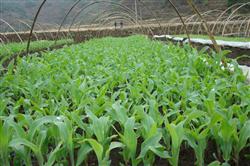
The spring corn sowing period is approaching, and in production, seedling cultivation and transplanting should be done well to promote early and steady growth of corn and achieve high and stable yields.
Fertilizing the seedbed: For transplanting with nutrient pot seedlings, prepare a seedbed 1.5 m wide and 20 m long for each mu of field, apply 250 kg of decomposed organic fertilizer, 2.5 kg of compound fertilizer, and 2.5 kg of urea in the bed, turn and crush evenly, then make pots, and promptly build arched sheds and cover with film. For transplanting with plastic tray-grown young seedlings, prepare a seedbed 1.5 m wide and 2.2 m long for each mu of field, and use 12 rice seedling trays with 561 holes. After sowing, promptly fertilize and prepare the field, and cover the transplanting rows with plastic film 65-80 cm wide to ensure timely transplanting. Currently there is more rain, so it is advisable to vigorously promote and apply the tray-grown young seedling plastic film transplanting method to resist natural disasters.
Seed treatment: For seedling cultivation and transplanting, use 1.5 kg of seed per mu of field; for direct sowing, use 2.5-3 kg per mu. Before sowing, choose sunny days to sun the seeds for 2-3 days to enhance seed activity and increase germination rate. Sow by grade to improve emergence rate and uniformity.
Timely sowing and transplanting: The suitable sowing period for spring corn differs depending on the sowing and transplanting method. For tray-grown young seedling transplanting, the suitable sowing period is March 15-20, seedling age 15 days, and transplanting at the leaf stage from 1 leaf 1 heart to before the 2-leaf stage; for nutrient pot seedling transplanting, the suitable sowing period is March 20-25, seedling age 30 days, and transplanting at the 3-leaf 1-heart stage; directly sown corn is generally sown at the end of March and early April, using the shallow furrow dibbling method. For fresh-eating green corn cobs, sowing can be done in batches with a sowing interval of 10-15 days to extend the marketing period.
Apply sufficient base fertilizer: Generally, 10 days before transplanting, apply 1250 kg of decomposed organic fertilizer, 25 kg of ternary compound fertilizer, and 25 kg of ammonium bicarbonate as base fertilizer per mu of field.
Master the density: Spring corn is suitable for intercropping and relay intercropping, and transplanting density varies among fields. In multiple cropping systems, such as interplanting corn with watermelon, it is advisable to plant 2 rows of corn on each side of the furrow, with a plant spacing of 23 cm and about 1500 plants per mu; for other intercropped and relay-intercropped corn, it is advisable to maintain a small row spacing of 50 cm, a large row spacing of 67 cm, and a plant spacing of 17-20 cm, with about 5000 plants per mu. For transplanting corn on vacant stubble, make beds 2.3 m wide with a ditch width of 27 cm, plant 4 rows per bed, with a plant spacing of 23 cm and about 5000 plants per mu.
Pest control: The main pests on early spring corn are cutworms and aphids. To control cutworms, bait can be used at the corn seedling stage (mix 0.5 kg of 90% crystalline trichlorfon with 2.5-5 kg of water and spray it on 50 kg of roasted rapeseed cake or cottonseed cake) for trapping and killing; the amount of bait depends on the area. Alternatively, use 100 ml of 48% chlorpyrifos emulsifiable concentrate per mu mixed with 50 kg of water for ground spraying or pouring. To control aphids, imidacloprid mixed with water can be used for spraying.