How to Grow Lettuce for High Yields? A Detailed Guide to Cultivation Techniques
Lettuce seeds are grayish-white or dark brown achenes, with a thousand-seed weight of about 0.8 to 1.2 grams. Before sowing, treat the seeds with 70% Dexon at 0.3% of the seed weight. Lettuce seeds have low temperature requirements for germination; seeds can germinate at around 4°C, so sowing can begin in late March. Before sowing, water the seedbed thoroughly, ...
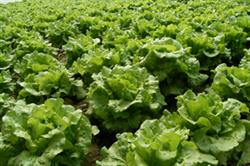 Lettuce prefers a cool climate and grows vigorously at 12-13°C. The optimum temperature for head growth is 16-18°C. High temperatures tend to make the heads loose and cause bolting. Lettuce likes ample sunlight and grows vigorously in sandy loam or light clay loam. The cultivation period should run from late autumn to early spring of the following year, that is, from mid-to-late October to mid-to-early April of the following year.
Lettuce is generally grown by raising seedlings and then transplanting. The following points should be noted:
1. Determining the sowing date. Head lettuce seedlings take about 30 days, and about 60 days after planting they can be marketed. Therefore, production can be reasonably arranged according to the planting and marketing times, with harvests staged over time.
2. Seed treatment. Seeds can be sown dry, or soaked to promote germination before sowing. For dry sowing, dress the seeds with 75% chlorothalonil wettable powder at 3% of the dry seed weight, and sow immediately after dressing. For soaking to promote germination, soak in clean water at 20°C for 3-4 hours, rub and wash, drain off the water, then place in gauze or an earthenware basin and keep at 20°C for 2-3 days to promote germination. Once sprouting is uniform, they can be sown.
3. Sowing. Begin raising seedlings in mid-to-late September. Choose sandy loam or light clay loam as the cultivation site. Prepare the soil 7-10 days before sowing, requiring the seedbed soil to be fine and level. For every 10 sq m of seedbed, use 10 kg of sieved manure and 50 g of monopotassium phosphate. Before sowing, water the seedbed thoroughly; after the water seeps in, mix the seeds evenly with sand and broadcast them, then cover with 0.5 cm of soil. Head lettuce uses 20-25 g of seed per mu, and 6-8 sq m of seedbed area is needed to plant 1 mu.
4. Management after sowing and during the seedling stage. After sowing, maintain 20-25°C during the day and 15-18°C at night, and keep the bed surface moist; seedlings can emerge uniformly in 3-5 days. After emergence, lower the temperature, maintaining 18-20°C during the day and 12-14°C at night. When the seedlings have 2-3 true leaves, prick them out at a plant and row spacing of 6 cm x 8 cm; when they have 5-6 true leaves, transplant them.
5. Transplanting. Apply 5000 kg of decomposed farmyard manure and 10-15 kg of nitrogen, phosphorus and potassium compound fertilizer per mu. Level the soil and make beds 0.8-1 m wide. The planting spacing for head lettuce is 25 cm x 35 cm, with about 7500 plants per mu.
Cultivation management
1. Temperature. Maintain 16-20°C before heading, 17-18°C during the heading stage, and a soil temperature of 15-20°C.
2. Fertilizer and water management. After transplanting, keep the soil alternating between dry and moist, and loosen the soil by hoeing in combination with watering. When the plants have 8-9 leaves and during the head-forming stage, apply 8-10 kg of ammonium nitrate per mu in combination with watering. In the late heading stage, control watering to avoid causing soft rot.
3. Harvesting. About 50 days after transplanting, harvest gradually according to market demand, but the harvesting period should not be too long, so as to avoid head splitting and reduce marketability.
4. Pest and disease control. The main insect pest is aphids, which can be controlled with 40% dimethoate emulsifiable concentrate at 1000-2000 times dilution, or sprayed with 50 ml of 25% kuishaling mixed with 50 kg of water.
The main diseases are downy mildew, gray mold and soft rot. For downy mildew, spray the undersides of leaves with 40% fosetyl-aluminum wettable powder at 200-250 times dilution or 58% metalaxyl-mancozeb wettable powder at 500 times dilution. For gray mold, spray 50% carbendazim wettable powder at 600-700 times dilution, once every 7-10 days, for 3-4 consecutive sprays. For soft rot, use 72% agricultural streptomycin soluble powder at 3000-4000 times dilution, spraying once every 10 days, for 2-3 consecutive sprays.