Symptom Identification and Control Techniques for Lettuce Gray Mold
A reader from Jiangsu asks: what are the symptoms and control methods of lettuce gray mold? Answer: Lettuce gray mold mainly damages leaves and stems, and infection can occur from the seedling stage to the mature plant stage. Infection at the seedling stage. Leaves and young stems show water-soaked rot, with gray mold growing on the diseased parts. Leaf infection. It starts from the mature leaves near the ground...
A reader from Jiangsu asks: what are the symptoms and control methods of lettuce gray mold?
Answer: Lettuce gray mold mainly damages leaves and stems, and infection can occur from the seedling stage to the mature plant stage.
Infection at the seedling stage. Leaves and young stems show water-soaked rot, with gray mold growing on the diseased parts.
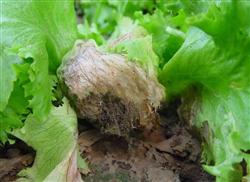
Leaf infection. It starts from the mature leaves near the ground; initially, small water-soaked spots appear, which after expanding become grayish-brown and irregular in shape. During continuous overcast and rainy weather, when field humidity is high, the diseased areas expand rapidly and spread to the inner leaves; under high humidity, a thick, dense layer of gray mold forms, namely the pathogen's conidiophores and conidia.
Stem infection. Initially, small water-soaked spots appear at the base of the stem; after expanding, the lesions encircle the stem. When field humidity is high, a thick, dense layer of gray mold forms, causing the stems and leaves above ground to wilt, and the diseased plants gradually dry up and die.
Control Measures
(1) Crop rotation. Advocate a 2-3 year rotation with non-Asteraceae vegetables or with grass-family crops.
(2) Thorough and careful land preparation. Apply fully decomposed organic fertilizer, apply sufficient base fertilizer, cultivate with deep furrows and high beds, and regularly clear the ditch system to prevent water accumulation after rain from causing disease.
(3) Strengthen cultivation management. Sow and transplant at the appropriate time, plant at a reasonable density, pay attention to ventilation in greenhouse cultivation, and adjust the microclimate inside the greenhouse, focusing on ecological disease prevention, so that the plants grow robustly and their disease resistance is improved.
(4) Clean up the field. After harvest, promptly remove diseased plant residues and carry them out of the field for deep burial or burning, which can reduce disease occurrence. At the same time, plow the soil deeply to accelerate the decomposition of diseased residues.
(5) Chemical control. Begin spraying at the early stage of disease onset, spraying once every 7-10 days, for 2-3 consecutive sprays. Optional agents include 40% Shijiale suspension concentrate at 800-1000 times dilution (75-100 grams per mu), 50% Sumilex wettable powder at 800-1000 times dilution (100-125 grams per mu), 50% iprodione wettable powder at 1000 times dilution (100 grams per mu), etc.