What to Do When Broccoli Gets a Viral Disease? Disease Patterns and Key Control Points
Viral disease is a major disease of broccoli, occurring commonly and severely. The disease patterns and control methods of this disease are described below: 1. Disease patterns In areas where cruciferous vegetables are not grown in winter, the virus overwinters on stored Chinese cabbage, cabbage, radish or overwintering spinach; when cruciferous vegetables are grown in winter, ...
Viral disease is a major disease of broccoli, occurring commonly and severely. The disease patterns and control methods of this disease are described below:
1. Disease patterns
In areas where cruciferous vegetables are not grown in winter, the virus overwinters on stored Chinese cabbage, cabbage, radish or overwintering spinach; when cruciferous vegetables are grown in winter, the virus overwinters inside the host plant. The green peach aphid, turnip aphid, cabbage aphid and others transmit the virus source to various cruciferous vegetables, causing disease in many vegetables. Under high temperature and drought, with high soil temperature, the growth and development of the host root system are affected, disease resistance is significantly reduced, and aphids reproduce quickly and move about frequently, causing the disease to occur widely. If management is extensive, the soil is dry, and water and fertilizer are lacking, the disease becomes severe. Disease resistance varies among different varieties.
2. Symptoms
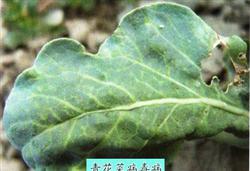
This disease is more severe at the seedling stage. Initially, nearly round small chlorotic spots appear on the leaves; later the entire leaf becomes paler in color, or green mottling of alternating light and dark appears. As the disease progresses, the leaves shrink and become distorted and deformed, and finally the whole plant dies. When infected at the mature plant stage, besides uneven light and dark mottling on the young leaves, dark brown necrotic spots sometimes also appear on the underside of old leaves, or are accompanied by vein necrosis. Finally the diseased plant becomes stunted and deformed, with twisted petioles; in mild cases the head becomes smaller, and in severe cases no head forms at all.
3. Control methods
1. Select relatively disease-resistant varieties according to local conditions, such as Luling and Gasta.
2. Use rational intercropping, relay intercropping and crop rotation, keep away from other cruciferous vegetables, and promptly pull out and remove severely diseased plants when found.
3. Use insect-proof net covering cultivation techniques, apply more organic base fertilizer, pay attention to frequent light watering and to controlling aphids, and control the occurrence and spread of the disease.
4. In the early stage of the disease, spray 20% Virus A wettable powder at 500 times dilution or 1.5% Zhibingling emulsion at 1000 times dilution, or spray a compound foliar fertilizer, to suppress the disease and enhance the disease resistance of broccoli.