Spring management of wheat: focus on preventing and controlling the four major harms
How to manage the first spring irrigation and fertilization of wheat? The first spring irrigation and spring fertilization have a great impact on wheat yield. For example: if the wheat is too dense, too sparse, or lodging occurs in the later growth stage, it indicates that the timing of the first spring fertilization and irrigation was problematic. Another example: if the wheat stays green and ripens late, and the grains are shriveled and thin, that indicates your spring water and fertilizer use...
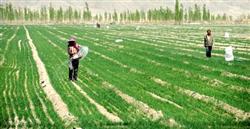 Spring management of wheat plays a decisive role in wheat yield. Therefore, doing a good job of management in spring wheat fields and preventing the occurrence of the "four harms" is the key to ensuring a bumper wheat harvest.
Preventing and controlling "fertilizer harm"
Apply sufficient base fertilizer: apply 5000-10000 kg of organic fertilizer, 20 kg of urea or 40 kg of ammonium bicarbonate or 30 kg of diammonium phosphate, 10 kg of potassium sulfate, and 2-5 kg of wheat-specific micro-fertilizer; at green-up, apply 20 kg of diammonium phosphate and 5 kg of potassium sulfate per mu as a topdressing; at flag-leaf stage, apply 10 kg of urea as a topdressing, or spray a 0.3-0.4% potassium dihydrogen phosphate solution during the grain-filling stage; use balanced fertilization and avoid applying chemical fertilizer alone; the formula ratio (nutrient content) is N:P:K=3:1:3; when applying organic fertilizer, be sure to use fully decomposed organic fertilizer, do not use "raw" fertilizer, to prevent the effect of "raw" fertilizer on wheat roots; when fertilizing, pay attention to the fertilization method and technique; after chemical fertilizer is applied to the field, it must be deeply applied more than 5 cm and covered with soil; do not apply it shallowly or leave it bare, to prevent volatilization from causing "seedling burn" to the wheat seedlings.
Preventing and controlling "water harm"
Dig drainage ditches around the wheat field so that excess water can drain away due to excessive irrigation; when preparing the wheat field, the soil should be broken up and the land should be level, with no uneven plots, to facilitate irrigation; when irrigating wheat, be careful not to irrigate too much; it is best if the water infiltrates within 2 hours after irrigation, and do not leave "standing water" overnight; if wheat needs to be planted in plots where the groundwater level is too shallow, find a way to dig ditches around them so that groundwater can seep into the ditches and the wheat can grow safely.
Preventing and controlling "pesticide harm"
When using pesticides to prevent and control pests and diseases, be sure to do a good job of forecasting and monitoring pests and diseases, know the situation clearly, target the problem precisely, and avoid unnecessary control, which causes a waste of manpower, material resources, and financial resources; the pesticide concentration used should not be too high or too low; if too high, wheat suffers pesticide harm and the environment is also polluted; if too low, it is unfavorable for pest and disease control, causing continuous and repeated pesticide application, increasing expenses, and likewise polluting the environment; the pesticide varieties used must be appropriate; pesticides for controlling insect pests must not be used to control diseases, and pesticides for controlling diseases must not be used to control insect pests; the techniques and methods of use must be correct: spray when spraying is required, and drench the roots when root drenching is required; after use, spray equipment must be rinsed clean with alkaline water, to prevent using it again after spraying herbicides without cleaning it, which causes pesticide harm to wheat.
Preventing and controlling "heat harm"
For wheat fields with excessive density, adopt techniques such as shallow hoeing, deep plowing, and pressing during winter and early spring management to limit the continuous increase in density, so that the density is about 800,000 maximum seedlings per mu in winter and about 1,000,000-1,100,000 per mu in spring; fertilize late, fertilize less, apply less nitrogen fertilizer, and apply more phosphorus and potassium fertilizer; during spring management of wheat, be sure to strengthen water management, as water deficiency easily causes dry hot wind damage; strengthen spring management measures so that the wheat root system is well developed and the stems are thick and strong, relying on its own ability to resist dry hot wind; if dry hot wind occurs, apply foliar supplements such as "Maifeng", "photosynthetic micro-fertilizer", and "naphthalene acetic acid" to protect it.