Detailed Explanation of Key Points for Bitter Melon Greenhouse Cultivation Techniques
High-yield and high-benefit cultivation techniques for bitter melon in winter-warm plastic greenhouses as protected cultivation. Select a winter-warm greenhouse with good lighting and strong insulation as the horticultural facility for off-season bitter melon cultivation. Compared with cucumber, loofah, and zucchini, bitter melon requires relatively higher light intensity and higher temperatures for growth and development, and has poorer tolerance to low temperatures and weak light. Bitter melon...
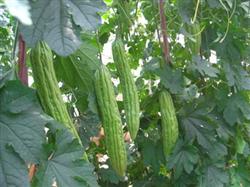
High-yield and high-benefit cultivation techniques for bitter melon in winter-warm plastic greenhouses as protected cultivation
Select a winter-warm greenhouse with good lighting and strong insulation as the horticultural facility for off-season bitter melon cultivation. Compared with cucumber, loofah, and zucchini, bitter melon requires relatively higher light intensity and higher temperatures for growth and development, and has poorer tolerance to low temperatures and weak light. If light is insufficient during the seedling stage of bitter melon, cold resistance will decrease; if light is insufficient during the fruiting stage, photosynthesis will be hampered, easily causing flower and fruit drop and slowing fruit enlargement. Bitter melon germinates with difficulty below 13°C, stops growing during the seedling stage below 12°C, suffers cold injury when exposed to temperatures below 10°C for more than 2 hours, and suffers freezing injury when exposed to temperatures below 8°C for more than 4 hours. Therefore, when cultivating bitter melon off-season during the cold winter and spring periods in northern China using winter-warm greenhouses (solar greenhouses) as protected cultivation, a winter-warm greenhouse with high light transmittance, rapid warming, and good insulation must be used. The winter-warm greenhouse used is required to meet the following specifications:
1. The greenhouse surface angle should be within the optimal range, that is, the optimal greenhouse surface angle range equals the local geographic latitude minus the solar declination at the "Winter Solstice" (-23°27'), then minus the parameter of 33 to 35 degrees. For example, for a region at 38 degrees north latitude, the optimal greenhouse surface angle range = 38° - (-23°27') - 33° to 35° = 26°27' to 28°27'. With such a greenhouse surface angle, even at the "Winter Solstice" when the sun altitude is at its lowest, the solar incidence angle on the light-transmitting surface of the front slope of the greenhouse is 55 to 57 degrees (that is, an incidence angle of 35 to 33 degrees), and the light transmittance of the greenhouse film reaches over 82%.
2. The wall and back slope layers of the winter-warm greenhouse should reach the proper thickness. The wall of the Shouguang winter-warm greenhouse is required to be earthen. This is because the volumetric heat capacity of dry soil is 2.5 joules/cm2·1°C, which is 2000 times the volumetric heat capacity of air at 0.0003 cal/cm2·1°C. Therefore, the wall not only plays a role in cold protection but also has a heat storage function. A winter-warm greenhouse with a thicker wall stores more heat and has stronger insulation, which can effectively slow the temperature drop inside the greenhouse at night, so that the minimum nighttime temperature inside the greenhouse in severe winter will not be too low, and can prevent "cold injury" and "freezing injury" to crops inside the greenhouse. The earthen wall of the Shouguang winter-warm greenhouse should have a thickness of: the local maximum frozen soil layer thickness plus 50 cm. For example, in a place where the local maximum frozen soil layer in severe winter is 80 cm, the greenhouse wall thickness should be 130 cm. The back slope layer consists of two layers of plastic film sandwiching dry grass and mud, and its proper thickness is 1/3 of the wall thickness.
3. In terms of greenhouse temperature regulation, it can reach the insulation standard for thermophilic vegetables. Under normal temperature management conditions such as covering for insulation, the absolute minimum temperature inside the greenhouse in severe winter (at night) is not lower than 8°C, and the time below 10°C is brief (less than 2 hours). Generally, the nighttime temperature inside the greenhouse can be controlled above 12°C; one and a half hours after the straw mats are uncovered in the morning, the temperature inside the greenhouse can rise above 18°C; on sunny midday in severe cold winter, without ventilation for cooling, the temperature inside the greenhouse can reach above 32°C; when the straw mats are covered in the afternoon (around 16:00 in winter), the temperature inside the greenhouse can be maintained at 21 to 22°C. Only a winter-warm greenhouse that meets the above requirements for warming and insulation standards is suitable for off-season cultivation of bitter melon.