What causes deformed kidney beans?
First, spraying drugs to which kidney beans are sensitive: Kidney beans are sensitive to mancozeb, zineb or diethofencarb-type drugs, and excessive application can easily cause pod bending. Kidney beans are extremely sensitive to oxadixyl, and phytotoxicity easily occurs, causing pod deformity. Some kidney beans also suffer phytotoxicity from spraying copper preparations or anthracnose fumei, with mild cases showing bent pods...
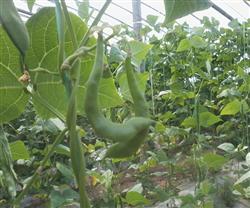
First, spraying drugs to which kidney beans are sensitive: Kidney beans are sensitive to mancozeb, zineb or diethofencarb-type drugs, and excessive application can easily cause pod bending. Kidney beans are extremely sensitive to oxadixyl, and phytotoxicity easily occurs, causing pod deformity. Some kidney beans also suffer phytotoxicity from spraying copper preparations or anthracnose fumei, with mild cases showing bent pods and severe cases showing leaf and pod drop.
Second, boron deficiency: When kidney beans are deficient in boron, it is not easy for them to set pods, and even if pods are set, the flowers are large and the pods are long and curved, with poor marketability. The solution is to spray a 1200-fold solution of Sule boron before the kidney beans flower.
Third, temperature too high or too low: The suitable temperature for kidney bean growth is 23°C~25°C during the day and 18°C at night. If the daytime temperature is lower than 20°C or higher than 30°C, pod setting of kidney beans will be affected. At noon during the flowering period, be sure to go into the greenhouse to observe the temperature and regulate the greenhouse temperature well.
Fourth, soil too dry or too wet: If the greenhouse soil is too dry or has too much standing water, it is easy for the just-set pods to develop a curved hook. This is because soil that is too dry or too wet injures the root system, causing the plant to weaken and affecting flowering and pod setting. Watering should be determined according to soil moisture conditions, and flood irrigation should not be used, so as to avoid root rot and root damage.
Fifth, excessive use of growth inhibitors: When vegetable growers spray excessive inhibitors such as chlormequat and difenoconazole on kidney beans that are growing vigorously but cannot set pods, it easily causes kidney beans to develop curved hooks. Some vegetable growers, when spraying naphthaleneacetic acid to prevent pod drop, cause pod bending because the concentration is too high. When spraying growth inhibitors, be sure to prepare and use them according to the instructions, and do not overdose.
Sixth, soil solution concentration too high: Excessive application of chemical fertilizers or saline-alkali land can cause pod deformity. In response, less chemical fertilizer should be applied and more humic acid-type fertilizers should be applied. After the pods grow to 3~4 cm long, 15~30 kg of humic acid-type fertilizer can be applied per mu by flushing to supplement nutrients. Absolutely avoid excessive chemical fertilizer application causing an increase in soil solution concentration and causing pods to bend. For planting kidney beans in saline-alkali land, it is best to use soilless cultivation to avoid direct contact between the kidney bean root system and the saline-alkali land, which affects root growth.