It's the perfect time to plant dwarf kidney beans, and the start of autumn is a great time to sow
1. Grow strong seedlings. Kidney beans have a short seedling stage and poor root regeneration, so they should be sown directly. If raising seedlings, root-protecting seedling raising must be done using nutrient pots. The base fertilizer should be mainly organic fertilizer, combined with phosphorus and potassium fertilizers, and special care should be taken not to lack phosphorus. 2. Seedling hardening. Kidney beans are prone to flower and pod drop, so water control for seedling hardening must be carried out at the early flowering stage. ...
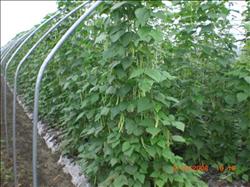 Dwarf kidney beans are sown directly around the start of autumn, and harvesting can begin after about 40 days. Cultivation is relatively simple and the benefits are relatively high, and they are grown in many areas of Shouguang.
I. Variety selection For planting dwarf kidney beans, varieties should be chosen that are heat-tolerant, strongly disease-resistant, highly adaptable, and have a high pod-setting rate.
II. Reasonable dense planting In the early growth period of dwarf kidney beans, the temperature is relatively high and the plants grow relatively fast; in the later period, the temperature gradually drops and fewer side branches form, so appropriate dense planting is necessary, relying on increasing the number of plants per unit area to raise the yield. Generally, a plant spacing of 60 cm and a hole spacing of 20 cm is relatively suitable. Ridge sowing in holes is usually adopted, with 3-4 seeds per hole. When selecting seeds, seeds propagated in the spring of the same year must be used.
III. Fertilizer and water management When planting kidney beans, it is not suitable to apply too much nitrogen fertilizer as base fertilizer. Since the seedling stage of kidney beans is still in a high-temperature season, evaporation is relatively large and more water is needed, so watering should be done in time to retain moisture and lower the temperature. At the early flowering stage, appropriately control water, and after pods set, the amount of watering can be appropriately increased. Combined with watering, apply 1-2 topdressings of NPK compound fertilizer, with about 15-20 kg per mu each time.
IV. Pest and disease control When planting autumn-crop dwarf kidney beans, the main diseases that occur are anthracnose and rust.
Anthracnose On leaves, the disease initially appears on the underside of the leaf and along the veins as reddish-brown streaks, then turns dark brown or black and expands into angular net-like spots. The lesions on petioles and stems are sunken and cracked, appearing as brown rust-colored thin strip-like spots, and the lesions merge to form long strips. When the disease is severe and humidity is relatively high, red sticky material exudes from the kidney bean lesions. You can alternately spray 70% thiophanate-methyl wettable powder at 800 times and 80% carbendazim-thiram at 600 times.
Rust occurs in summer and autumn. This disease mainly infects leaves. At first, small yellow chlorotic spots with indistinct edges appear, about 1 mm in diameter; later the center slightly bulges and is deep yellow, and after the epidermis ruptures, reddish-brown powder is released. You can use 40% flusilazole emulsifiable concentrate at 8000 times and 10% difenoconazole water-dispersible granules at 2000 times for spray control.
The insect pests that commonly occur on kidney beans include aphids, red spiders, and pod borers, etc. You can choose to spray 10% imidacloprid at 1500 times for control.