Key Cultivation Techniques and Field Management of Golden Buckwheat Explained
Golden buckwheat is the dried rhizome of the Polygonaceae plant golden buckwheat, also known as bitter buckwheat, wild bridge buckwheat and heaven buckwheat. Its nature is cool, its taste pungent and bitter, and it has the effects of clearing heat and detoxifying, activating blood and resolving stasis, and strengthening the spleen and draining dampness. It is mainly produced in Shaanxi, Jiangsu, Zhejiang, Hubei, Hunan and other provinces, and can also be cultivated in the East China region. I. Morphological characteristics...
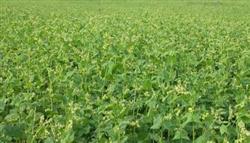
Golden buckwheat is the dried rhizome of the Polygonaceae plant golden buckwheat, also known as bitter buckwheat, wild bridge buckwheat and heaven buckwheat. Its nature is cool, its taste pungent and bitter, and it has the effects of clearing heat and detoxifying, activating blood and resolving stasis, and strengthening the spleen and draining dampness. It is mainly produced in Shaanxi, Jiangsu, Zhejiang, Hubei, Hunan and other provinces, and can also be cultivated in the East China region.
I. Morphological characteristics
Golden buckwheat is a perennial herb with a plant height of l-1.5 m. The main root is thick and large, nodular, growing horizontally, and red-brown. The stem is upright, slightly reddish, much branched, and has ridges and grooves. The leaves are simple and alternate; the leaf blade is halberd-shaped triangular, with a long, gradually pointed or tail-pointed tip, and a forward-shaped heart-shaped base; it has a petiole, and the petiole bears short white pubescence; the stipular sheath is tubular and membranous. The cyme is terminal or axillary, with 5 white perianth segments. The achene is ovate-triangular and red-brown. The flowering period is July-September, and the fruiting period is l0-l1.
II. Growth habits
Golden buckwheat has strong adaptability and prefers a warm climate. It grows well at temperatures of 15-30°C, and can overwinter safely when cultivated in areas around -15°C. It is suitable for planting in fertile, loose sandy loam, while planting in clay and poorly drained land results in poor yield and quality.
The seeds of golden buckwheat must absorb about 40% of their body weight in water before they can germinate. They can germinate within a temperature range of 8-35°C, with the suitable temperature being 12-25°C. Germination is inhibited when the temperature is below 8°C or above 35°C. When golden buckwheat is sown in April in the Beijing area, with a certain humidity maintained and a temperature in the range of 12-18°C, seedlings emerge in about 15 days, and 20 days is the peak emergence period.
III. Cultivation techniques
1. Land selection and land preparation. According to the growth habits of golden buckwheat, choose sandy loam with good drainage and high, dry terrain. Land preparation is generally carried out in spring, on the principle of not turning up raw soil, with a ploughing depth of 30-60 cm, and continuous ploughing and turning l-2 times. Combined with ploughing and turning, apply 2500-3500 kg of barnyard manure or compost per mu, then harrow finely and level, and make beds 1.5 m wide, with the length determined by the terrain of each place, generally 8-10 m.
2. Propagation methods. Seed propagation, rhizome propagation or cutting propagation are all acceptable.
(1) Seed propagation. Both spring and autumn sowing are acceptable, with spring sowing being better. For spring sowing in late April, open furrows at 45 cm for drilling, with a furrow depth of 3 cm, sow the seeds evenly, cover with soil, rake level, and press lightly. After sowing, the soil should be kept moist. Under conditions of 10-18°C, seedlings emerge in 15-20 days; autumn sowing should be later, with sowing in late October or November. After sowing, cover the bed surface with grass, and the seeds overwinter in the soil, emerging in April of the following year, with an emergence rate of up to 60%-80%. Seedling raising and transplanting can also be carried out: in the Beijing area, seedlings can be raised in a greenhouse or cold frame in early to mid-March. In the prepared cold frame, water thoroughly, and after it has completely seeped down, sow in drills at a row spacing of 5-8 cm, cover with 2 cm of soil, cover the bed surface with plastic film, and cover with spread grass at night. Seedlings emerge in 7-10 days. When 2-3 true leaves appear, transplant at a plant and row spacing of 30 cm x 45 cm.
(2) Rhizome propagation. Before the plants sprout in spring, dig out the rhizomes, select healthy rhizomes and cut them into small sections, open furrows at a row spacing of 45 cm with a furrow depth of 10-15 cm, then plant the rhizomes into the furrows at a plant spacing of 30 cm, cover with soil and press firm. Generally, the young and tender parts of the rhizomes and the rhizome buds are selected as propagation material, and both the emergence survival rate and the yield are high.
(3) Cutting propagation. Cut fully developed branches 15-20 cm long with 2-3 nodes, use river sand as the seedbed, insert the cuttings to a depth of 2/3, with a plant and row spacing of 9 cm x 12 cm. Keep the seedbed moist. When cuttings are taken in summer, they root after about 20 days, with a survival rate as high as more than 90%.
3. Field management
(l) Weeding. Weed frequently during the seedling stage, and loosen the soil 2-3 times.
(2) Topdressing. Apply topdressing once when the seedlings are 50-60 cm tall, or before flowering, using 15-20 kg of chemical fertilizer per mu.
(3) Drainage and irrigation. Note that in the rainy season, drainage should be timely; in drought, water appropriately according to soil moisture.
4. Pest and disease control
(1) Aphids. Their nymphs suck the sap of golden buckwheat stems and leaves. Control methods: 1) In winter, clean the garden and bury deeply or burn the dead branches and fallen leaves to eliminate overwintering insects; 2) During the occurrence period, spray with 40% dimethoate emulsion at 1500 times dilution or 80% dichlorvos emulsion at 1500 times dilution.
(2) Viral disease. It damages the leaves, and the damaged leaves become mosaic-like or curled and shrunken. Control methods: 1) Select disease-free plants for seed retention, or treat the seeds before sowing to inactivate the virus; 2) Control the vectors, remove diseased branches, and clear field weeds, etc., to reduce the sources of infection in the field.
(IV) Harvesting and processing Timely harvesting and correct processing and drying methods are especially important for golden buckwheat; correct harvesting and processing can achieve high yield and excellent quality. It is generally dug up in autumn and winter when the aboveground stems and leaves wither. At harvest, cut off the stems and leaves, dig out the roots, remove all soil and mud, take out some robust, disease-free rhizomes for use as seed, and dry and process the rest for medicinal use. Generally, the yield per mu can reach 250-400 kg; the aboveground part, including stems, leaves and flowers, reaches a yield of 500-900 kg and can also be used medicinally.
The cleaned golden buckwheat roots can be sun-dried, or sliced fresh and then sun-dried. Drying methods: sun-drying, shade-drying, and drying within 50°C are all acceptable, but note that the temperature during drying should not be too high, and it is best not to exceed 50°C. If this temperature is exceeded, the quality of the medicinal material will decline markedly. Golden buckwheat is considered best when large and hard in texture.