Detailed Explanation of Key Points for Autumn Tartary Buckwheat Cultivation Techniques
(1) Variety selection. Mainly select tartary buckwheat varieties with many branches, concentrated seed set, early seed set, high seed-setting rate, strong cold resistance, and high yield. (2) Fine land preparation. Land preparation should be done carefully, with a tillage depth of about 20 cm, clearing residues of the previous crop and weeds, which is beneficial for sowing and emergence; deep plowing and fine harrowing should be done to make the land level...
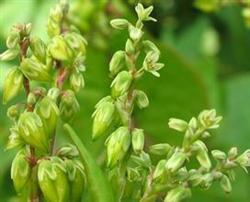
(1) Variety selection. Mainly select tartary buckwheat varieties with many branches, concentrated seed set, early seed set, high seed-setting rate, strong cold resistance, and high yield.
(2) Fine land preparation. Land preparation should be done carefully, with a tillage depth of about 20 cm, clearing residues of the previous crop and weeds, which is beneficial for sowing and emergence; deep plowing and fine harrowing should be done to make the land level, and attention should be paid to digging ditches for drainage.
(3) Sowing at the appropriate time. When there is no competition for land with other crops, sow as early as possible to avoid frost damage later. Areas in our county where buckwheat is grown should sow before the Start of Autumn. The sowing depth depends on the soil type of the growing area, and 3-4 cm is appropriate; sandy loam should be slightly deeper, while clay loam should be slightly shallower, with uniform soil covering thickness.
(4) Reasonable close planting. Sowing density depends on soil fertility conditions, and the sowing rate is generally controlled at 5-7 kg per mu. When using hill sowing, the row spacing is 30-35 cm, and the hill spacing is about 20 cm; when using drill sowing, the sowing width is 10-12 cm, and the row spacing is 30 cm.
(5) Scientific fertilization. Fertilizer application should follow the principle of "applying sufficient base fertilizer, applying topdressing early, and applying phosphorus and potassium fertilizer appropriately." Use 750-1,000 kg of farmyard manure and 15-30 kg of superphosphate per mu as base fertilizer. If weak seedlings appear at the 3-4 true leaf stage, use 2.5-5 kg of urea per mu to promote seedling growth. At the early flowering stage, 0.15-0.2 kg of potassium dihydrogen phosphate and 0.5-1 kg of urea per mu can be mixed with 60-75 kg of water and sprayed 2-3 times to ensure sufficient nutrient supply in the later stage, reduce bud and flower shedding, and increase the seed-setting rate.
(6) Field management. (1) Thinning. When seedlings are at the 3-4 true leaf stage, thin seedlings in plots and sections where seedlings are too dense, removing weak ones and keeping strong ones, removing dense ones and keeping sparse ones. Ensure about 200 seedlings per sq m. (2) Promote branching and control excessive growth. Under field conditions with higher water and fertilizer levels, growth is vigorous. At the early budding stage, spray 40-50 kg of 100-200 ppm paclobutrazol solution per mu, which has the effect of reducing plant height, increasing branching, resisting lodging, and increasing yield, with a yield increase of more than 15%. (3) Pest control. Focus on pest control at the flowering stage, with pest control at the seedling stage as a supplement. Use pesticides such as Kung Fu and Decis to control 2-3 times.
(7) Timely harvest. When 2/3 of the grains in the whole plant are mature and brown or silver-gray, it is the suitable harvest period. To reduce grain shattering losses, harvesting should be carried out after the morning dew dries and before 11 a.m., and cutting should be done gently and placed down gently. After cutting, dry in a shed for after-ripening for a few days, and thresh nearby to reduce losses.