How to manage greenhouse peppers after spring planting?
Early spring greenhouse peppers are generally planted from mid-February to early March, then watered thoroughly with bottom water; after the water seeps in, earth up in stages, seal the holes, and seal the plastic mulch planting openings tightly. At this time, pay attention to the following three management tasks: timely temperature control and ventilation. After planting, the temperature outside the greenhouse is still low, so attention should be paid to heat preservation, keeping the daytime temperature at 22-30°C...
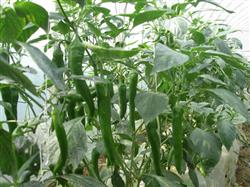
Early spring greenhouse peppers are generally planted from mid-February to early March, then watered thoroughly with bottom water; after the water seeps in, earth up in stages, seal the holes, and seal the plastic mulch planting openings tightly. At this time, pay attention to the following three management tasks:
Timely temperature control and ventilation. After planting, the temperature outside the greenhouse is still low, so attention should be paid to heat preservation, keeping the daytime temperature at 22-30°C and the nighttime temperature at 12-22°C. If a cold wave occurs, a small arched tunnel can be added inside the greenhouse for insulation. As the weather warms, gradually increase ventilation: open the center seam during the day, uncover and roll up the side seams, and at night leave the center seam open to continue ventilation.
Reasonable watering and fertilizing. At planting, water thoroughly; in the early stage, water as little as possible. If watering is needed, choose a sunny morning and apply dark water under the mulch. After the peppers begin to swell, choose sunny and warm weather to water once under the mulch; afterward, keep the soil moist and avoid the soil alternating between dry and wet. In the high-temperature season of the late growth period, small amounts of water can be applied frequently in the morning and evening to regulate soil and air humidity.
When the peppers grow to about 3 cm, along with intertillage, broadcast 2500 kg of decomposed organic fertilizer and 700 kg of plant ash per hectare; after the peppers set fruit, apply 200 kg of urea per hectare with irrigation water; after the "four mother peppers" set fruit, apply 15000 kg of decomposed human manure and urine per hectare with irrigation water, and thereafter apply 200 kg of compound fertilizer per hectare with irrigation water every 20 days.
Pay attention to preserving flowers and fruits. Pepper flower and fruit drop is an important factor affecting yield. To effectively prevent flower and fruit drop, in addition to strengthening field management, hormone treatments should also be used. In addition to strengthening field management, hormone treatments should also be used to improve the fruit-setting rate. Green peppers have reached full size about 20 days after flowering, but the skin is thin and the flavor is bland, so they are not suitable for harvest. Generally, about 35 days after flowering, when the flesh becomes thicker, the skin becomes harder, and the skin color turns dark green, harvesting is best; at this time, the single fruit is heaviest, resistant to compression, and easy to store and transport.