Key Field Management Techniques for Spring-Planted Peppers
In open fields, this disease is mainly of the leaf rot type, while in protected cultivation it is mainly of the root rot type. In protected cultivation, pepper Phytophthora blight mostly invades from the root crown, and the diseased part is dark brown. Sunken or shrunken, the lesion can encircle the stem and cause root death, and the plant wilts. In greenhouses, the pathogen is mainly spread by irrigation water, and disease centers mostly form in low-lying, waterlogged, and soil...
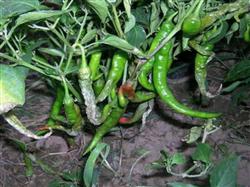 (1) Field preparation: Before transplanting, irrigate the field thoroughly to build up bottom moisture. Per mu, apply 5000 kg of high-quality decomposed organic fertilizer, 200 kg of cake fertilizer or 1000 kg of chicken manure, 50 kg of ammonium bicarbonate, 50 kg of superphosphate, 20 kg of potassium sulfate, and 20 kg of micronutrient fertilizer, then deeply plow and harrow thoroughly until the soil is fine and the ground is level.
(2) Ridge formation and film mulching: Form ridges in the field 0.85 m wide and 0.1 m high, with 0.35 m between ridges. The ridges should be level and straight to make film laying convenient. Lay 0.9 m plastic film, with 0.3 m between film edges.
(3) Field transplanting: In mid-to-late April, that is, after the last frost, carry out field planting. For farmers who are able, a small amount of active potassium fertilizer can be used per pepper plant to ensure normal growth of the seedlings. When planting, do not poke holes with a steel bar, to prevent compacting the soil, which is unfavorable for seedling root growth.
(4) Field management: After transplanting, it is exactly the period of temperature transition, and peppers are in the seedling revival stage and a weak growth stage. At this time, attention should be paid to the harm from aphids and diseases. A mixed solution of imidacloprid, carbendazim, and virus inhibitor can be sprayed. At the same time, field humidity should be maintained to promote early and rapid growth and ensure that peppers get through the critical seedling revival period.
(5) Rational topdressing: The basic principle of topdressing peppers is "control nitrogen, stabilize phosphorus, supplement potassium, and combine with micronutrients," as follows:
1. Light application of seedling fertilizer: This stage runs from seedling revival to before flowering. The purpose of fertilization is to promote robust growth of the transplanted seedlings and lay a foundation for flowering and fruiting. Topdressing at this stage is mainly compound fertilizer.
2. Steady application of first-fruit fertilizer: This stage runs from flowering to before the first harvest. The main purpose of fertilization is to promote branching, flowering, and fruit set in pepper plants. Topdressing is mainly nitrogen, phosphorus, and potassium compound fertilizer, using 25 kg per mu; 5 kg of boron fertilizer can be added per mu to increase the fruit-setting rate.
3. Heavy application of peak-fruiting fertilizer: When peppers enter the peak fruiting stage, this is the period of greatest fertilizer demand in the entire growing season. Fertilization is mainly nitrogen, phosphorus, and potassium compound fertilizer, 30-40 kg per mu, with an appropriate increase in potassium fertilizer, about 10 kg per mu, combined with a certain amount of micronutrient fertilizer. Under normal circumstances, after each topdressing, water promptly to promote the absorption of nutrients by peppers and improve fertilizer use efficiency. At the same time, it can also increase field humidity, which is beneficial for flowering and fruit set.
4. Later-stage supplementary fertilizer: In the later stage, foliar topdressing can be carried out by spraying. Specifically, urea, potassium dihydrogen phosphate, and other micronutrient fertilizers can be used.
(6) Intertillage and film breaking: In the middle growth stage of peppers, watering, fertilizing, rainfall, and other farming operations can easily cause soil compaction and damage to soil moisture. Before the rows close, the film should be broken in time for intertillage to promote deeper root growth and prevent premature senescence. The depth and extent of intertillage should be based on not damaging the root system. Generally speaking, timely watering after intertillage and hilling is beneficial to pepper growth. If field management throughout the entire growth period of peppers is done well, the plants grow robustly, the stress resistance of peppers is relatively enhanced, disease damage is lighter, the number of pesticide applications can be reduced, production costs are lowered, yield increases, and the quality of peppers can also be improved.
(7) Pest and disease control: The main pepper pests are aphids, cotton bollworms, and diamondback moths, while the main diseases are damping-off, Fusarium wilt, anthracnose, bacterial wilt, bacterial spot, viral disease, and Phytophthora blight. Aphids are the transmission vector of viral disease, so attention should be paid to controlling aphids. Imidacloprid or pyrethroid pesticides can be used for control, and they also have good control effects on cotton bollworms and diamondback moths. Damping-off, Fusarium wilt, Phytophthora blight, and anthracnose are fungal diseases and can be sprayed for control with carbendazim, thiophanate-methyl, or Tuzet. Bacterial wilt and bacterial spot are bacterial diseases and can be controlled with streptomycin or Xinzhiromycin. Viral disease is caused by a virus, so aphid control as the main means of disease prevention should be the main approach, and plant disease inhibitor or virus inhibitor can be sprayed for control.
Overall, pests should be controlled early, and diseases should be prevented first. Before disease onset, by combining aphid control with a small amount of carbendazim, chlorothalonil, or thiophanate-methyl, viral disease can be effectively controlled, achieving the purpose of disease and pest prevention.