What are the key technical points for controlling rice false smut?
Rice is susceptible to infection during the heading and flowering stage, and the pathogen damages some grains on the panicle. At first, a pale yellow-green mass appears at the seam of the glumes, gradually expands, and finally covers the entire glume shell. It is 3-4 times larger than a healthy grain, dark green, with a smooth surface, and later splits open, releasing dark green powder. Weather is closely related to the occurrence of rice false smut;...
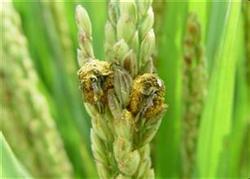
Rice is susceptible to infection during the heading and flowering stage, and the pathogen damages some grains on the panicle. At first, a pale yellow-green mass appears at the seam of the glumes, gradually expands, and finally covers the entire glume shell. It is 3-4 times larger than a healthy grain, dark green, with a smooth surface, and later splits open, releasing dark green powder. Weather is closely related to the occurrence of rice false smut. When there is a lot of continuous rainy and high-humidity weather, the occurrence of rice false smut is more severe. Excessive application of nitrogen fertilizer causes rice to remain green and mature late, which aggravates the occurrence of the disease, and diseased panicles and diseased grains also increase accordingly. Generally, two applications are required. For the first application, when the last leaf of more than 1/3 of the stems in the entire field has fully emerged, commonly known as the "large booting" stage, apply the fungicide (about 5-7 days before heading). This is exactly the peak period of initial infection by the pathogen, so seizing the opportunity and applying the fungicide promptly at this time gives the best control effect. For the second application, apply the fungicide once more at the stage of panicle emergence after the boot splits, to consolidate and improve the control effect. Validamycin, carbendazim, difenoconazole-propiconazole, and other agents can be selected and applied according to the requirements.