What are the control measures for cabbage yellow leaf disease (defoliation disease)?
Yellow leaf disease in cabbage-type vegetables is a general term for fungal-type yellow leaf disease of cabbage-type crops. Heading cabbage, yellow-bud cabbage and other Chinese cabbages, and pak choi are all affected by yellow leaf disease from north to south. Symptoms appear at the seedling stage. The damaging fungus is Verticillium fusarium of the genus Brassica, belonging to the Deuteromycotina. This disease can be controlled through chemical spraying or field...
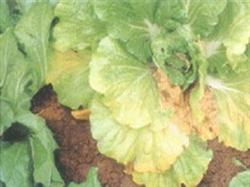
Yellow leaf disease in cabbage-type vegetables is a general term for fungal-type yellow leaf disease of cabbage-type crops. Heading cabbage, yellow-bud cabbage and other Chinese cabbages, and pak choi are all affected by yellow leaf disease from north to south. Symptoms appear at the seedling stage. The damaging fungus is Verticillium fusarium of the genus Brassica, belonging to the Deuteromycotina. This disease can be controlled through chemical spraying or field management.
I. Disease symptoms. Heading cabbage, yellow-bud cabbage and other Chinese cabbages, and pak choi are all affected by yellow leaf disease from north to south. Symptoms appear at the seedling stage. After final thinning or transplanting, growth is slow, the leaves on one side turn chlorotic, causing half the plant or the whole plant to wilt as if short of water. When the diseased plant is pulled up, there are few fibrous roots, and when the main root is cut open, the vascular bundles are browned. After the rosette stage and up to the early heading stage, the leaves begin to yellow; entering the mid-heading stage, the tissue between the veins of the old leaves fades and turns yellow, while the areas around the veins mostly remain dark green; later the leaf margins lose water, shrivel and curl inward, causing the plant to become stunted or die.
II. Pathogen characteristics. Verticillium fusarium of the genus Brassica, a fungus of the Deuteromycotina. The stroma and mycelium are initially white, later gradually turning brown to pink. There are two types of conidia, large and small: the large conidia are few, cylindrical to sickle-shaped, pointed at both ends, with a small protrusion at the base, mostly with 2 to 3 septa, measuring 25-33 x 3.5-5.5 microns; the small conidia are numerous, oval to elliptical, single-celled, measuring 6-15 x 2.5-4 microns; chlamydospores are terminal or intercalary, and no conidiomata, sticky conidial masses or sclerotia are produced.
III. Transmission route. The fungus survives in the soil. In dry years, when the soil temperature is too high or stays too high for too long, the root system distributed in the plow layer is scorched, and secondary roots extend slowly, which not only affects water uptake by the seedlings but also gradually causes the roots to become suberized, leading to disease.
IV. Disease conditions. According to surveys, this disease causes severe damage in Shaanxi, Hubei, Yunnan, Sichuan and other places in some years or under off-season cultivation, becoming an important disease in cabbage production.
V. Control methods
(1) Select disease-resistant varieties.
(2) Sow at the appropriate time, generally not too early, and avoid the high-temperature and dry season as much as possible.
(3) Strengthen field management. Control the seedlings moderately, change the habit of "full-month" seedling control, prevent soil drought at the seedling stage, and in dry years at the seedling stage when the ground temperature is too high, water frequently to lower the temperature so as to ensure normal root development.
Chemical methods
(1) Avoid flood irrigation at the seedling stage. After thinning, promptly spray once with "Aigenuo + Kaipuke".
(2) When setting out the large trays, drench the roots once with 50% carbendazim 1000g + 30% hymexazol aqueous solution 100ml + Japanese granular magnesium 3000g, using about 200ml of medicinal solution per plant.
(3) During the barrel-forming period, drench the roots once per mu with 50% carbendazim 1000g + 75% chlorothalonil 1000g + potassium dihydrogen phosphate 2kg, using about 150ml of medicinal solution per plant.
(4) Apply less nitrogen fertilizer and more phosphorus, potassium and magnesium fertilizer.
(5) When combining with insect and disease control, add 30% hymexazol aqueous solution (10ml per bucket of water).
(6) When plowing and preparing the land, "humic acid" can be added in real time at 80kg-100kg per mu.