How to grow off-season cabbage? Detailed planting techniques
1. Spray rice vinegar: From the rosette stage to the heading stage of Chinese cabbage, spray a 300-500 times diluted rice vinegar solution, once every 7-10 days, for 2-3 consecutive sprays, which can increase yield by 15%-30%. 2. Spray rare earth: At the rosette stage, heading stage, and hearting stage, spray 0.03%, 0.05%, and 0.08% rare earth nitrate solutions respectively, for a total of 3 sprays,...
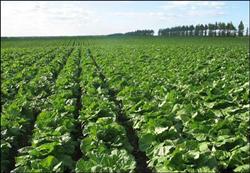 Growing off-season agricultural crops with scientific management can shorten the time, save labor, and thereby improve economic benefits. Let me tell you about off-season cabbage.
1. Select excellent varieties: Mainly choose varieties with early maturity, high yield, good quality, and strong heat resistance.
2. Sow at the right time, raise seedlings in fertile beds: Sowing can be done from mid-April to late June. Choose a plot with higher terrain, convenient drainage, fertile and loose soil, and sunny exposure as the seedling bed. The previous crop must not have been a cruciferous vegetable. Prepare the land 10 days before sowing. The seedling bed should be 1-1.5 m wide, with length depending on the terrain, 25-30 cm deep, and ditch width of 40 cm. Apply 100 kg of decomposed organic fertilizer per bed (or 40 kg of bio-organic fertilizer), and 2-3 kg of diammonium phosphate. Use 30-50 g of seed per mu, mix the seed evenly with fine sandy soil and broadcast it, then splash on 200-300 kg of dilute manure fertilizer, cover with a thin layer of soil, and water to moisten the seedling bed. Then cover with wheat straw curtains (rice straw curtains). Tip: If building a frame and covering with film, pay attention to timely ventilation.
3. Seedling stage management: After emergence, spray once every 7-10 days with leafy vegetable type Tianda 2116 plus arsenic insect powder, spraying 2-3 times during the entire seedling stage. Pay attention to weeding, thinning seedlings, and removing diseased and weak seedlings.
4. Transplanting and setting out: (1) Choose a plot with good drainage and fertile soil. (2) Apply sufficient base fertilizer, plow, level, and then make beds 15-20 cm high, 1 m wide, with bed ditches 25-30 cm wide, planting 3 rows per bed. (3) Transplant when the vegetable seedlings have 5-8 leaves. After planting, water with an appropriate amount of 800 times diluted Nongjiaole solution to reduce root damage, promote rooting, and shorten the recovery period.
5. Field management: Check and replant seedlings in time, apply fertilizer early, and spray leafy vegetable type Tianda 2116 plus Eba Ling combined with pest control. During the rosette stage and heading stage, timely apply multi-element compound fertilizer (or water-soluble fertilizer) by flushing, and avoid applying urea alone. Prevent and control aphids, cabbage caterpillars, and other pests early, and choose pesticides for control.