Key Techniques and Operation Methods for Grafting Eggplant onto Tomato
With the development of protected agriculture, eggplant can be grown year after year, so soil-borne diseases such as eggplant Verticillium wilt have become the main obstacle affecting eggplant production. We use tomato (Maofen 802) as the rootstock to graft eggplant, which not only effectively prevents eggplant Verticillium wilt, bacterial wilt and other diseases, but also produces tall and uniform plants, good fruit quality and high yield...
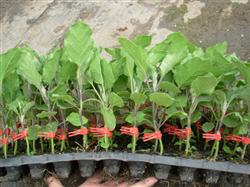
With the development of protected agriculture, eggplant can be grown year after year, so soil-borne diseases such as eggplant Verticillium wilt have become the main obstacle affecting eggplant production. We use tomato (Maofen 802) as the rootstock to graft eggplant, which not only effectively prevents eggplant Verticillium wilt, bacterial wilt and other diseases, but also produces tall and uniform plants, good fruit quality and high yield. For grafted eggplant seedling production, we mainly use two methods: cleft grafting and approach grafting.
I. Cleft grafting: grafting is generally best when the rootstock and scion have 5-6 true leaves. Cut the rootstock horizontally with a blade at a height of 3 cm, keep the lower 2-3 true leaves, remove the remaining leaves, then use the blade to make a vertical cut 0.8-1.2 cm deep in the middle of the stem; pull up the graft seedling, keep 2-3 leaves at the top, cut it off horizontally, and sharpen it into a wedge shape, with a size matching the rootstock cut, generally 0.7-1.1 cm, then insert the scion into the rootstock so that the cut surfaces fit together evenly, secure it well with a grafting clip, and the grafting is complete. It survives after about 10 days, with a survival rate of 90%. After the graft union has completely healed, remove the clip, and it can be planted out after about 30 days.
II. Approach grafting: carry this out when the rootstock and scion have grown to 2-3 true leaves. Make a slanting cut between the 1st and 2nd true leaves, cutting downward on the rootstock and upward on the scion, with a cut of about 0.5 cm; align the cut surfaces well and secure them with a grafting clip.
III. Notes on grafting: first, the blades and clips used for grafting must be washed and disinfected, and the seedlings must be handled carefully to keep them clean, free of soil and not wilted. Second, during grafting, move quickly and accurately, succeeding in one attempt. For open-air grafting, choose a cloudy day without rain or after 4 p.m. on a sunny day, so the seedlings recover quickly and the survival rate is high.