Detailed Explanation of the Key Techniques for Year-Round Cultivation of Grafted Eggplant
With the expansion of eggplant cultivation area and continuous year-after-year planting, various soil-borne diseases have become quite common, and the degree of damage is also increasing, such as eggplant Verticillium wilt, Fusarium wilt, and bacterial wilt. In old eggplant-growing areas, soil-borne diseases have become a stubborn problem limiting eggplant production, and conventional pesticide control is not effective. Grafting has become...
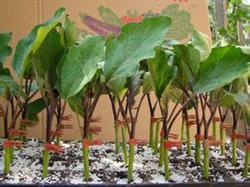
With the expansion of eggplant cultivation area and continuous year-after-year planting, various soil-borne diseases have become quite common, and the degree of damage is also increasing, such as eggplant Verticillium wilt, Fusarium wilt, and bacterial wilt. In old eggplant-growing areas, soil-borne diseases have become a stubborn problem limiting eggplant production, and conventional pesticide control is not effective. Grafting has become an essential means to overcome soil-borne diseases and increase eggplant yield and profitability. Grafted eggplant has strong resistance and vigorous growth, allowing year-round production. According to our 3 years of large-scale trials and demonstrations in Shangqiu City, year-round cultivation of grafted eggplant can increase yield by 40-50% compared with conventional cultivation, and in plots with severe disease, the yield can be multiplied. The year-round cultivation techniques for grafted eggplant are described below.
I. Grafted Eggplant Seedling Raising
The rootstocks commonly used for eggplant grafting include wild and semi-wild species such as Torubamu, Super Torubamu, red eggplant, and prickly eggplant. These rootstocks are highly resistant or immune to soil-borne diseases of eggplant such as Verticillium wilt, Fusarium wilt, bacterial wilt, and nematode disease, and are also cold-resistant, drought-resistant, and moisture-tolerant. At present, Torubamu is mostly used as the rootstock in production.
1. Sowing time. Sow the rootstock in early January. In order to make the optimal grafting period of the rootstock and scion coincide, the rootstock should be sown 25-30 days earlier than the scion; when using red eggplant as the rootstock, it needs to be 7-10 days earlier. Torubamu has a strong dormancy period, so at sowing time, treat it with 100-200 mg/kg gibberellin or soak it with a special rapid germination promoter for eggplant rootstocks to promote germination.
2. Management after sowing. After sowing the rootstock and scion and before emergence, the soil temperature is low, so heating is needed for emergence. The seedbed soil temperature requirement for the rootstock (Torubamu) is 30-35°C, and for the scion is 25-30°C. Eggplant seedlings are most susceptible to damping-off, so the seedbed soil should be mixed with chemicals such as carbendazim or miaojundi, with a layer underneath and a cover on top. After emergence, spray 2-3 times with 72.2% Previcur at 500 times dilution.
3. Transplanting seedlings. When the rootstock seedlings grow to 2-3 leaves, transplant them into 10 cm x 12 cm nutrient pots to facilitate grafting operations and field planting. If the scion seedlings are sown thinly, they do not need to be transplanted.
4. Grafting. Eggplant grafting generally uses the cleft grafting method. When the rootstock seedlings have 5-6 leaves and the scion seedlings have 3-4 leaves, this is the suitable grafting period. First, retain 2-3 leaves on the rootstock, cut the rootstock stem horizontally with a blade, remove the upper part, then split it from the middle of the stem and cut downward vertically 1-1.5 cm. Then remove the scion, retain the upper 2-3 leaves, cut off the lower part with a blade, and cut the cut surface into a wedge shape 1-1.5 cm long. The size of the wedge should match the cut on the rootstock. Immediately insert the scion into the cut, making sure the epidermis of the two cuts is aligned, and secure it with a grafting clip.
5. Management after grafting. After grafting, move the seedlings into a small arched tunnel as soon as possible for shading. Water thoroughly. Do not ventilate for the first 6-7 days, maintain humidity above 95%, keep the daytime temperature at 25-28°C and the nighttime temperature at 20-25°C. For the first 3-4 days after grafting, provide complete shading, then half shading. As the wounds heal, gradually remove the straw mats and gradually ventilate. During ventilation, maintain relatively high air humidity. After complete survival, switch to normal management.
II. Field Planting
1. Land preparation and fertilization. Eggplant is a deep-rooted crop with a long growth period and likes heavy water and heavy fertilizer. Before field planting, apply sufficient base fertilizer. Use 8000-10000 kg of well-fermented farmyard manure or chicken manure, 300-500 kg of cake fertilizer, and 50-100 kg of three-element compound fertilizer per mu. Deep plow 30-40 cm and rake smooth.
2. Field planting. Before planting, make high beds 15-20 cm high with wide rows of 70-80 cm and narrow rows of 50-55 cm. Open an irrigation ditch between the two narrow rows and cover with 1.1 m wide plastic film to facilitate root development, watering, and disease reduction. At planting time, the soil temperature should be above 12°C, the plant spacing should be 40-50 cm, and 2000-2500 plants should be planted per mu. At planting, first punch holes, water, and then plant. Be sure not to bury the graft union when planting; the graft union should be 3-5 cm above the ground to prevent the scion from rooting and being infected a second time. For early spring cultivation, covering with a small arched tunnel can greatly increase profitability.
III. Cultivation Management
1. Management during the vegetative growth period. 3-5 days after planting grafted eggplant, water once to help the seedlings recover. The amount of water should not be too large, to prevent the soil temperature from dropping. The key at this stage is to increase temperature and promote rooting so that the plants grow vigorously and lay a foundation for future high yield.
2. Hormone flower dipping. In order to ensure that the first eggplant sets, prevent flower drop, and promote rapid fruit expansion, hormone dipping is needed for the first eggplant. The method is: when the eggplant flower is half open, dip the flower with 40-60 mg/kg 2,4-D plus 100 mg/kg gibberellin. When dipping flowers, add 1-2 g of procymidone or iprodione per kg of solution. This can prevent flower drop, prevent disease, and promote early maturity. Generally, apply it with a writing brush above the sepals, and be careful not to use too much solution.
3. Water and fertilizer management. After the first eggplant fruit has set steadily, that is, when the first eggplant is the size of an egg yolk, it can be watered and top-dressed. The fertilization principle is to ensure sufficient nitrogen fertilizer while also combining phosphorus and potassium fertilizers. Apply 10 kg urea, 10 kg potassium sulfate, and 10 kg diammonium phosphate per mu, mix and apply in holes, and water. After the first eggplant is harvested, the opposite eggplant grows vigorously, and topdressing can be carried out together with watering. When topdressing, chemical fertilizer and organic fertilizer can be used in combination. Each time, apply 20 kg of three-element compound fertilizer or 1000 kg of organic fertilizer per mu.
4. Pruning and removing side shoots. Grafted eggplant has strong growth vigor and a long growth period. Do not keep side branches below the first eggplant. Generally, use the ordinary pruning method, retaining fruit according to the first eggplant, opposite eggplant, and four-door bucket. In the middle and late growth stages, remove old leaves and diseased leaves from the lower part, which can improve ventilation and light penetration, prevent fruit rot, increase coloring, and improve fruit quality.
5. Timely harvesting. Harvesting at the appropriate time when the fruit reaches physiological maturity not only gives good quality but also does not affect the development of the upper fruits. In particular, the first eggplant should be harvested appropriately early. Another principle is that when eggplant growth is vigorous, harvest appropriately later, and when growth is weak, harvest appropriately earlier. The best harvesting time is in the afternoon. When harvesting, use scissors to cut off the fruit stalk; do not twist or pull it forcefully.
IV. Pruning and Regrowth. As the fruiting position of eggplant rises, the plant grows too tall and is prone to lodging, the upper fruits are small, and the coloring is poor. Therefore, around the Beginning of Autumn, prune for regrowth at 10 cm above the position of the opposite eggplant. After pruning, remove all leaves on the plant, then apply 20-30 kg of three-element compound fertilizer per mu and water heavily once to promote the sprouting of new branches. After the new branches sprout, there will be many branches. Wait until the new branches are 5-10 cm long, keep 4 branches of similar vigor to bear fruit, and remove the rest. Practice has proved that after pruning and regrowth, grafted eggplant has vigorous growth, the eggplants grow large, the coloring is good, and there is another yield peak. Generally, 30-40 days after pruning, the second crop of eggplant can be marketed. Some farmers, in order to delay, do not harvest and additionally cover with a small arched tunnel and straw mats, delaying marketing until 30-50 days after Frost's Descent, achieving even higher profitability.
V. Pest and Disease Control
1. Diseases. After grafting, eggplant overcomes the most important soil-borne diseases such as Verticillium wilt and Fusarium wilt. The incidence is relatively mild, but there are also diseases such as brown spot and Phytophthora fruit rot that cause rotten eggplant in the field. For chemical control, use 75% Daconil at 500 times, 64% Sandofan at 500 times, 72% cymoxanil mancozeb at 600 times, and other chemicals.
2. Insect pests. The main pests of eggplant include red spider mite, tea yellow mite, and 28-spotted ladybird. In recent years, tea yellow mite has occurred severely and tends to develop further. It mainly damages tender leaves and fruits. After tender leaves are damaged, the leaf edges curl downward and the leaf backs become greasy. When fruits are damaged, the fruit surface becomes rough, and in severe cases the peel cracks and looks like a split steamed bun, losing edible value. For chemical control of tea yellow mite, spray at the early stage of occurrence with 1.8% abamectin at 3000 times, 5% hexythiazox at 1500 times, 15% pyridaben at 2000 times, 73% propargite at 1000 times, and other chemicals. When spraying, mainly spray the young tender parts and the undersides of leaves, and spray evenly and thoroughly.