How to prevent and control Verticillium wilt in eggplant without grafting? Detailed practical measures
Verticillium wilt is a common disease of eggplant, and grafting is an effective measure to control it, but some vegetable growers have already planted eggplant seedlings that were not grafted, so how should Verticillium wilt be prevented and controlled? The symptoms of the disease and control measures without grafting are introduced here. 1. Disease symptoms. The disease mainly damages leaves, and in each...
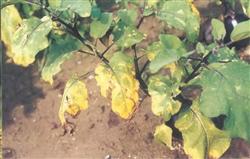
Verticillium wilt is a common disease of eggplant, and grafting is an effective measure to control it, but some vegetable growers have already planted eggplant seedlings that were not grafted, so how should Verticillium wilt be prevented and controlled? The symptoms of the disease and control measures without grafting are introduced here.
1. Disease symptoms
The disease mainly damages leaves, and can occur at all growth stages, with the heaviest occurrence during the fruiting stage. It generally starts on the middle and lower leaves first. In the early stage of the disease, some leaves on the lower part or one side first wilt at noon, resembling dehydration wilt, and can recover in the morning and evening. After repeating for several days, they no longer recover. The leaf color changes from yellow to brown, the leaf margins curl upward, and it gradually spreads upward until the whole plant is affected. When the roots, main stem, side branches and leaf stalks are cut open, the vascular bundles of affected plants can be seen to be yellow-brown or brown compared with healthy plants. Then the wilted parts or leaves continuously expand and increase, gradually spreading throughout the whole plant, causing the entire plant to wilt and die.
The Verticillium wilt pathogen invades through wounds and between the root hair cells of the root system, enters the vascular bundles and develops and multiplies in them, and flows with the plant sap to the stems, branches, leaves, fruits and seeds, forming a systemic infection. It can be infected from the seedling stage to the growth and development stage. It overwinters in the soil as dormant mycelium, chlamydospores and sclerotia with diseased residues, and can survive in the soil for 6 to 8 years. The suitable temperature for disease occurrence is 19°C to 24°C. The disease is severe in plots that are low-lying, improperly watered, repeatedly cropped, continuously cropped, or where undecomposed fertilizer is applied. When the temperature is 15°C to 25°C and the soil is moist or watering is too frequent, the incidence is high. Especially in repeatedly cropped land, low-lying land, land frequently hit by cold air, land lacking fertilizer or with excessive nitrogen fertilizer, and land where undecomposed fertilizer is applied, eggplant grows and develops poorly and has weak disease resistance, which favors the occurrence and spread of the disease.
2. Control measures
1. Choose disease-resistant varieties. Generally, early-maturing and low-temperature-tolerant varieties have strong resistance to Verticillium wilt. For example, Nongda 601, Kuaixing, Ziyue, Qieza No. 2, Qieza No. 9, Langgao, Ruima, Andelie and others all have good resistance to Verticillium wilt and Fusarium wilt.
2. Apply Bacillus subtilis. When the seedlings grow to 3 to 4 true leaves, drench the seedlings with 500 times dilution of Bacillus subtilis wettable powder. At transplanting, mix 1 part Bacillus subtilis wettable powder with 50 parts fine soil, and apply 50 grams per hole. At the eye-opening stage of the first eggplant, irrigate the roots with 1000 times dilution of Bacillus subtilis wettable powder, 250 milliliters per plant.
3. Chemical treatment. Irrigate the roots with 1000 times dilution of 2.5% Shileshi suspension concentrate, or 800 times dilution of 75% Daconil wettable powder, or 600 times dilution of 80% Dasheng wettable powder, or 500 times dilution of thiophanate-methyl wettable powder, or 500 times dilution of 50% carbendazim wettable powder, 250 milliliters per plant.
Vegetable growers are advised to use the green comprehensive prescription and carry out prevention and control according to the steps, so that eggplant is not troubled by diseases throughout the whole growth period. The disease prevention and control plan for early spring eggplant is:
Step 1: At transplanting, irrigate the roots with 500 times dilution of Bacillus subtilis wettable powder, 50 milliliters per plant;
Step 2: After 15 days, spray 75% Daconil wettable powder once;
Step 3: After 10 days, spray 1500 times dilution of Amistar suspension concentrate once;
Step 4: After 15 days, spray 1200 times dilution of 50% Ruizhen water-dispersible granules once;
Step 5: After 14 days, spray 40% Herui water-dispersible granules once;
Step 6: After 12 days, irrigate the roots with 800 times dilution of Bacillus subtilis wettable powder;
Step 7: After 12 days, spray 1500 times dilution of Amistar suspension concentrate once.