What causes the stems of eggplants to turn brown and rot?
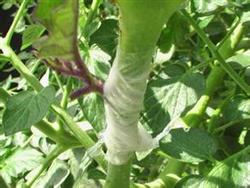
Vegetable grafting can produce new vegetable varieties to meet consumer demand. Grafting tomato onto eggplant is one such example. 1. Grafting time: because of differences in the nature, species and varieties of plants, as well as differences in climate, grafting methods and approaches from place to place, the choice of grafting time cannot be uniform. As for...
 The various symptoms that occur on eggplant are mainly caused by Phytophthora fruit rot and gray mold. Gray mold of eggplant produces large numbers of black hairs at the diseased site, whereas Phytophthora fruit rot of eggplant, when humidity is high, produces dense white cottony mycelium on the surface of the diseased part; this is the main difference between the two diseases. The control methods for the two diseases are described below:
For gray mold, on the premise of good heat preservation and humidity reduction, "Yixunling" No. 1 and No. 2 can be used at 75-100 g per standard greenhouse for fumigation (this avoids raising air humidity, and high air humidity is most conducive to the occurrence of gray mold), or 65% Jiameling 800-1000 times solution, or 50% Sukeeling 1500-2000 times solution, or 50% Puhaiyin 1000-1500 times solution, or 75% Dakoning 600-800 times solution, or 40% Shijiale 1000 times solution, etc., spraying once every 7-10 days depending on the severity of the disease, for 2-3 consecutive sprays.
For Phytophthora fruit rot, 53% Jinlei Duomier manganese zinc 600-800 times solution, or 64% Shadufan 500-600 times solution, or 52.2% DuPont Yikuaijing 2000 times solution, or 20% Longkejun 600 times solution, etc. can be used, spraying on the leaves once every 7-10 days depending on the severity of the disease, for 2-3 consecutive sprays. For the rotted parts of eggplant stems, the above agents can be mixed with water into a paste and applied.