What exactly is causing the spots on eggplant stems and leaves?
The small spots on eggplant leaves are lighter in the middle with dark brown edges, and the larger ones become irregular. There are also many small black dots on the lesions. Many leaf stalks have dark brown necrotic spots. After the stems are affected, dark brown lesions also appear, with dark brown edges and a lighter middle, and they are also densely covered with small black dots...
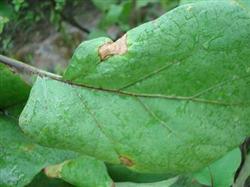
The small spots on eggplant leaves are lighter in the middle with dark brown edges, and the larger ones become irregular. There are also many small black dots on the lesions. Many leaf stalks have dark brown necrotic spots. After the stems are affected, dark brown lesions also appear, with dark brown edges and a lighter middle, and they are also densely covered with small black dots. Severely affected plants die from the affected part of the stem upward. Fruit infection is relatively rare, with only a few fruits showing brown spots with black dots.
Analysis: Long eggplant is mainly infected by eggplant brown spot disease, not eggplant early blight. The typical symptoms of eggplant brown spot disease are: first, the lesion color is pale in the middle and dark brown around the edges; second, the lesions have concentric rings; third, in the later stage the lesions are densely covered with small black dots, and there are necrotic spots on the leaf stalks and stems. Although eggplant early blight can also cause spots on eggplant leaves and stem discoloration and necrosis, the typical symptoms of eggplant early blight are brown small spots on the leaves with concentric rings and yellow halos around them, while the stems become watery and rotted. The main reason vegetable growers' disease control results are unsatisfactory is that they have not identified which disease is infecting the eggplant, resulting in the wrong pesticide being used.
Control recommendations: Because eggplant brown spot disease develops severely and spreads quickly when humidity in the greenhouse is high and there is a lot of dew on the leaf surface. When branches and leaves are too dense for air to pass through, vigorously growing plants are more severely affected. Vegetable growers can start from these aspects, combined with medication, to control eggplant brown spot disease.
First, in management practices, the priority should be reducing humidity in the greenhouse and reducing dew on the leaf surface. It is recommended that vegetable growers use subsurface irrigation under plastic film or drip irrigation when watering, to avoid a large increase in greenhouse humidity after watering. After watering and during routine management, attention should be paid to closing the greenhouse in time to raise temperature and remove moisture. Spread crop straw between operation rows to absorb moisture. In deep winter, when humidity in the greenhouse is high, spraying powder for disease prevention can be used instead of spraying liquid.
Second, after long eggplant fruits are harvested, promptly remove old leaves, yellowed leaves, and excess branches from the lower part of the plant to increase ventilation and light penetration between plants and rows. During periods when disease is frequent, foliar fertilizers such as nucleotides and Luye Jingang can be sprayed on the leaves to enhance leaf stress resistance.
Third, correct pesticide use is crucial. According to the disease occurrence pattern, early spraying for prevention is very important. During periods when disease is frequent, 75% chlorothalonil 600-fold solution or iprodione 500-fold solution can be sprayed early for prevention. After infection, 65% zineb wettable powder 500-fold solution or Kebo 600-fold solution can be chosen, generally spraying once about every 7 days, for 2-3 consecutive sprays.