How to do cross-pollination in eggplant? A detailed explanation of the management technique key points
The most suitable temperature for eggplant flowering and fruiting is 25-30°C. Below 17°C or above 40°C, fertilization and fruiting cannot occur. The flowers open at around 6 a.m., and the anthers begin to split after 7 a.m., so the suitable pollination time each day is after 8 o'clock. For cross-pollination, on the afternoon of the day before the female parent's flower opens, select buds whose corolla has emerged to 1/2 of the bud, light purple, and not yet open, and emasculate them. Emasculation must be thorough to avoid false hybrids. On the next day, when the male parent's flowers open, collect pollen (pollination with pollen from flowers opening on the same day gives the highest fruit-setting rate), and smear the pollen onto the stigma of the female parent. The paired eggplant (2 fruits) and the four-door fruit (1 fruit) should be selected for crossing. After the crossed fruit sets, all other buds should be removed. According to experiments, repeated pollination can increase the seed yield of F1 (i.e., the first hybrid generation) by 10%.
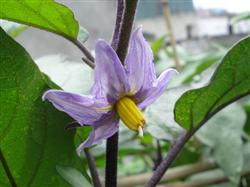
The most suitable temperature for eggplant flowering and fruiting is 25-30°C. Below 17°C or above 40°C, fertilization and fruiting cannot occur. The flowers open at around 6 a.m., and the anthers begin to split after 7 a.m., so the suitable pollination time each day is after 8 o'clock. For cross-pollination, on the afternoon of the day before the female parent's flower opens, select buds whose corolla has emerged to 1/2 of the bud, light purple, and not yet open, and emasculate them. Emasculation must be thorough to avoid false hybrids. On the next day, when the male parent's flowers open, collect pollen (pollination with pollen from flowers opening on the same day gives the highest fruit-setting rate), and smear the pollen onto the stigma of the female parent. The paired eggplant (2 fruits) and the four-door fruit (1 fruit) should be selected for crossing. After the crossed fruit sets, all other buds should be removed. According to experiments, repeated pollination can increase the seed yield of F1 (i.e., the first hybrid generation) by 10%.
Field management of the cross-seed production field should be strengthened, and pests and diseases should be controlled in a timely manner. In case of severe drought, irrigate; after rain, drain promptly, and take care not to let the seed fruits touch the ground. 55-60 days after pollination, when the seed fruits are fully yellow-brown and mature, pick the seed fruits, let them after-ripen for 5-7 days, then cut out the seeds, dry them until the seed moisture content is about 7%, bag them, and store them under dry and cool conditions for later use.