How to prevent and control eggplant Phytophthora fruit rot? These methods must be mastered
Eggplant Phytophthora fruit rot, commonly known as fruit rot and watery rot, is one of the important diseases of eggplant and occurs commonly in all regions. Eggplant can be affected at all growth stages. Losses are generally 20-30%, and more than 50% in severe cases. The peak fruiting period is also the peak disease period, and in rainy regions and years it often breaks out into disaster, causing devastating losses. 1. Disease identification...
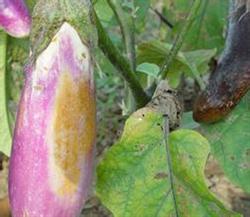
Eggplant Phytophthora fruit rot, commonly known as fruit rot and watery rot, is one of the important diseases of eggplant and occurs commonly in all regions. Eggplant can be affected at all growth stages. Losses are generally 20-30%, and more than 50% in severe cases. The peak fruiting period is also the peak disease period, and in rainy regions and years it often breaks out into disaster, causing devastating losses.
1. Disease identification
It mainly damages the fruit. Fruits near the ground are affected first, initially showing water-soaked round spots, which then expand to cover the entire fruit. The lesions are slightly sunken, yellow-brown or dark brown, and the flesh is black-brown, rotting and easily falling off. When humidity is high, dense white cottony mycelium grows on the surface of the diseased part, and affected fruits easily drop from the stem, or shrink to form mummified fruit. It can also damage leaves, stems and flowers. When young stems are infected, water-soaked, dark green or purplish-brown lesions form, and the stems become constricted or break. When humidity is high, sparse white mold grows, and the leaves above wilt and droop. When leaves are affected, irregular or nearly round water-soaked brown lesions with obvious concentric rings are produced. When moist, sparse white mold grows on the lesions. When seedlings are affected, the base of the hypocotyl becomes water-soaked and necrotic, causing damping-off.
2. Conditions for disease occurrence
Eggplant Phytophthora fruit rot is a fungal disease. The oospores of the pathogen overwinter in the soil or on diseased residues. The following year, they first infect fruits, stems and leaves near the ground through wind and rain splash, and the sporangia produced on the lesions are then spread through wind, rain and irrigation. High temperature and high humidity, sudden clear weather after rain, excessive plant density, poor ventilation and light penetration, low-lying terrain, and sticky heavy soil are conducive to the disease.
3. Control methods
1. Select disease-resistant (tolerant) varieties. Because eggplant varieties differ greatly in resistance to Phytophthora fruit rot, experience from various regions holds that round-eggplant types are more resistant than long-eggplant types. For example, Beijing's Jiuye Qie, Tianjin's Denglong Hong, Shandong's Wuxing Qie, etc. The main reason for disease resistance and tolerance is the smooth fruit surface, which makes it difficult for water droplets and water mist to remain. In the absence of water droplets and water mist, even if sporangia are present, they do not have the conditions to germinate. In addition, thick-skinned varieties are more resistant than thin-skinned varieties, and early-maturing varieties are more resistant than late-maturing varieties.
2. Plastic film mulching. Using black plastic film to cover the ground or laying it between rows can block the splash spread of pathogen spores from the soil to the eggplant fruits, thereby achieving a good disease-prevention effect. It can also use sunlight for high-temperature sterilization and prevent weed growth.
3. Practice crop rotation. Plots should be arranged reasonably, and continuous cropping with Solanaceae and Cucurbitaceae crops such as tomatoes and peppers should be avoided. This is because, in addition to damaging eggplant, the Phytophthora fruit rot pathogen can also damage crops such as tomato, pepper, potato, cucumber and pumpkin. Generally, a crop rotation and stubble-changing system of more than 3 years should be practiced.
4. Carefully select the site. Attention should be paid to selecting plots with high, dry terrain and good drainage, and deep furrows and high beds should be used for cultivation, which is beneficial for drainage after rain. Avoid cultivation in low-lying land, and try to avoid plots with sticky heavy soil that easily accumulate water after rain.
5. Scientific fertilizer and water management. Apply sufficient decomposed farmyard manure, increase the application of phosphorus and potassium fertilizers, and topdress in a timely manner. Irrigate gently with small amounts of water without accumulating water. After heavy rain at noon, immediately irrigate with clear water to suppress infection and enhance the disease resistance of the plants.
6. Fine management. Prune in a timely manner, remove old lower leaves, improve field ventilation and light penetration conditions, promptly remove diseased leaves and diseased fruits, and carry diseased residues out of the field to prevent reinfection.
7. Chemical control. Before eggplant transplanting, spray the seedbed with 50% captan wettable powder at 500 times dilution so that the seedlings are transplanted with the chemical. After the seedlings recover from transplanting, spray 70% zineb wettable powder at 500 times dilution for protection. When the disease first appears and central diseased plants are found, they should be immediately pulled up and destroyed, and pesticide should be sprayed for control. During the fruiting period, especially before the rainy season, pesticide should be sprayed for protection to prevent the disease. Some farmers start from the beginning of the rainy season and spray 1:1:200 Bordeaux mixture once every 7 days for protection, with very good results. Once the disease occurs, pesticide must be applied immediately. Pesticides include 75% chlorothalonil at 500-600 times dilution, 50% thiophanate-methyl wettable powder at 800 times dilution, 40% fosetyl-aluminum wettable powder at 200 times dilution, 64% oxadixyl-mancozeb at 500 times dilution, etc. Generally, spray once every 7-10 days, for 3-4 consecutive sprays. To prevent the development of pesticide resistance, different types of pesticides should be used each time.