How should base fertilizer be applied to eggplants? These methods need to be mastered
Sclerotinia rot is an important disease on early-spring greenhouse eggplants in coastal areas in recent years. It can occur from the seedling stage to the mature plant stage, with the most severe damage during the early flowering and fruiting period, often causing the buds and young fruits of the first eggplant and the second eggplant to rot and drop, the main stem and branches to die, and early yield to drop sharply. Symptoms of the disease: at the seedling stage, the disease starts at the base of the stem, ...
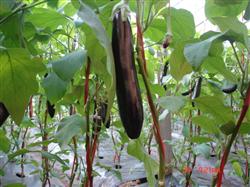 Eggplant has a long growth and fruiting period, with deep roots and lush leaves. It is a vegetable crop that needs a lot of fertilizer and is also tolerant of fertilizer. Applying sufficient base fertilizer is the foundation for obtaining high yield. If the greenhouse uses plastic film mulching cultivation, because topdressing later is inconvenient, most of the fertilizer should be applied as base fertilizer. The amount of fertilizer applied differs between old greenhouses and new greenhouses. This is because old greenhouses have more residual nutrients in the soil than new greenhouses, so new greenhouses should be fertilized more than old greenhouses. In most old greenhouse soils, nitrogen is excessive, phosphorus is accumulated, and potassium is insufficient.
The methods that can be adopted are
(1) Apply 6000 kg of organic fertilizer per 667 sq m. If it is an old greenhouse, the application rate can be reduced, and 20-30 kg of potassium sulfate can be added. Organic fertilizer and potassium fertilizer should be spread evenly over the whole area and then turned into the soil. Special attention should be paid to the fact that organic fertilizer must be fully decomposed, preferably treated with a professional fermentation agent (such as Jinbaobei fermentation agent). This can not only reduce nutrient loss, but also thoroughly remove pathogens, insect eggs, and other exogenous harmful substances from the organic fertilizer.
(2) Apply microbial fertilizer in combination, such as 1-2 kg of Jinbaobei microbial fertilizer per mu. It is even better to mix it evenly with farmyard manure, chemical fertilizer, or fine soil and then apply it in furrows, in holes, or by broadcasting.