What to do when tomatoes get bacterial spot? Symptoms and chemical control methods
★Symptoms: Tomato leaves, stems and fruits can all be infected by bacterial spot. The old leaves near the ground are affected first, with initial water-soaked dark green spots that enlarge into nearly round or irregular brown lesions with distinct edges, surrounded by a narrow yellow halo ring, thinner in the center and with a greasy sheen. Stems, when infected, first develop water-soaked dark green to yellowish-brown...
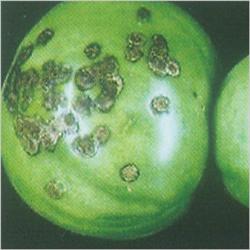
★Symptoms: Tomato leaves, stems and fruits can all be infected by bacterial spot. The old leaves near the ground are affected first, with initial water-soaked dark green spots that enlarge into nearly round or irregular brown lesions with distinct edges, surrounded by a narrow yellow halo ring, thinner in the center and with a greasy sheen. When stems are infected, water-soaked dark green to yellowish-brown irregular lesions first appear, the affected part is slightly raised, and after cracking it becomes scabby. When fruits are infected, mainly young fruits and green fruits before coloring are affected, with initial round white dots with slightly raised narrow rings around them, which later become sunken in the middle and form dark brown or blackish-brown raised ring spots, scab-like, which is an important feature of this disease.
★Pathogen: Xanthomonas campestris pv. vesicatoria (Doidge) Dye (Xanthomonas vesicatoria (Doidge) Dowson), called the rape xanthomonad scab pathotype, or the pepper bacterial spot pathovar, is a bacterium. The bacterial cells are short rod-shaped with bluntly rounded ends, measuring 1.0-1.5 x 0.6-0.7 micrometers, with 1 flagellum at one end, Gram-stain negative, with an optimum growth temperature of 27-30°C, maximum 40°C, minimum 5°C, and killed at 56°C in 10 minutes. Besides infecting tomatoes, it also harms sweet (hot) peppers.
★Transmission routes and disease conditions: The pathogenic bacteria overwinter with diseased residues on the soil surface or attached to the seed surface. The following spring, when conditions are suitable, the pathogen spreads to tomato leaves, stems or fruits through wind and rain or insects, invades through wounds or stomata, multiplies between cells, and at the same time the affected cells are broken down, causing the affected parts to become sunken. The incubation period after infecting leaves is 3-6 days. After infecting fruits it is 5-6 days. High temperature, high humidity and rainy weather are important conditions for the disease, and boring insect pests and storms causing wounds, extensive management and weakened plants lead to more severe disease.
★Control methods:
(1) Use disease-free seeds, or disinfect diseased seeds. Soak the seeds in warm water at 55°C for 10 minutes, then move them into cold water to cool before sprouting.
(2) Practice a 2-3 year crop rotation in severely affected fields.
(3) Strengthen management, prune and remove side shoots in time, and control insects at the proper time.
(4) At the beginning of the disease, start spraying 47% Kasumin wettable powder at 600 times dilution, or 50% copper bis(dodecylbenzenesulfonate) (DT) wettable powder at 400-500 times dilution, or 77% Kocide wettable microparticle powder at 400-500 times dilution, 25% copper ammonia complex aqueous solution at 500 times dilution, streptomycin sulfate or streptomycin at 4000-5000 times dilution, once every 7-10 days, for 1 or 2 applications.