What chemical agents should be used to control tomato root-knot nematode disease?
In recent years, the occurrence of tomato root-knot nematode disease has shown an upward trend, especially in dry sandy loam soil where the disease is severe, causing great losses. Root-knot nematodes have a wide range of hosts; besides damaging tomatoes, cucumbers, sweet peppers and others also suffer severely. Root-knot nematodes often overwinter in the soil as eggs or second-stage larvae with galls, root knots, and diseased plant residues...
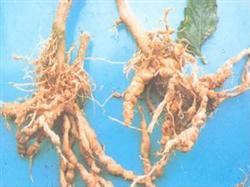
In recent years, the occurrence of tomato root-knot nematode disease has shown an upward trend, especially in dry sandy loam soil where the disease is severe, causing great losses. Root-knot nematodes have a wide range of hosts; besides damaging tomatoes, cucumbers, sweet peppers and others also suffer severely.
Root-knot nematodes often overwinter in the soil as eggs or second-stage larvae with galls, root knots, and diseased plant residues, and can generally survive in the soil for 2-3 years. When the soil temperature is suitable, the overwintering eggs or second-stage larvae invade the plant roots, stimulating root cell proliferation and forming root knots or root galls. The primary sources of initial infection are diseased soil, diseased seedlings, and irrigation water. When the soil temperature is 25°C-30°C and the soil moisture content is about 40%, the pathogenic nematodes develop fastest; they stop activity below 10°C, and at 55°C they can be killed in 10 minutes. Conditions of high terrain, dry soil, loose soil texture, and low salinity are favorable for root-knot nematode activity, resulting in severe disease; continuous cropping also results in severe disease. The control methods are as follows.
1. Practice crop rotation: Tomato, cucumber, and sweet pepper are important hosts of root-knot nematodes. In affected fields, continuous planting must not be practiced; instead, plant them with a 2-year interval from Chinese chives, garlic, and scallions. 2. Use disease-free soil for seedling raising: Use new soil or disease-free soil for seedling raising to prevent the spread of nematodes by diseased soil during transplanting. Apply decomposed manure as fertilizer to promote the reproduction of parasitic fungi of nematodes and reduce damage from adults. Root-knot nematodes are mostly distributed in the 3-9 cm soil layer, and deep plowing can reduce damage.
3. High-temperature greenhouse sealing: When pulling up vines of spring-crop tomatoes, the temperature is relatively high, and sealing the greenhouse in combination with deep plowing can kill nematodes or reduce population density. The specific method is: first remove diseased roots, then deep plow the soil, irrigate thoroughly and cover with plastic film, and carry out high-temperature greenhouse sealing so that the soil temperature rises to about 60°C.
4. Chemical control: When sowing or transplanting, apply 10% granules per 667 sq m in holes at 5 kg of granules, or 5% granules at 10 kg. If nematodes occur during the tomato growing season, management should be strengthened, diseased plant residues should be thoroughly removed and burned in a centralized manner or buried deeply, and root drenching should be done with 50% phoxim 1500-fold solution, 90% trichlorfon 800-fold solution, or 80% dichlorvos emulsifiable concentrate 1-fold solution, once every 7-8 days, for 2-3 consecutive applications.