What causes tomato leaf curl?
There are many causes of tomato leaf curl, mainly the following: 1. Viral disease. Viral diseases are generally spread by virus-transmitting insects such as aphids and whiteflies. Infected plants are stunted, with leaves curled and clustered, and in severe cases the leaves retain only veins with no mesophyll. Control: In addition to choosing virus-resistant varieties and implementing crop rotation, at the early stage of the disease, spray...
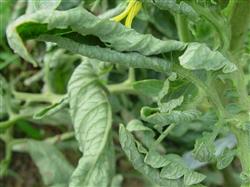
There are many causes of tomato leaf curl, mainly the following:
1. Viral disease. Viral diseases are generally spread by virus-transmitting insects such as aphids and whiteflies. Infected plants are stunted, with leaves curled and clustered, and in severe cases the leaves retain only veins with no mesophyll.
Control: In addition to choosing virus-resistant varieties and implementing crop rotation, at the early stage of the disease, spray a 1000-fold dilution of potassium permanganate, which can also control viral disease and soft rot and other diseases; you can also add 100 g of Virus A (K), 50 g of Lufenwei and 25-30 g of Yibianjing to 50 kg of clean water to make a mixed solution for spray control, once every 6-7 days, spraying 2-3 times in succession.
2. Hormone phytotoxicity. When hormones such as 2,4-D and chlormequat are used too much or at too high a concentration, tomato leaves or growing points become bent, new leaves cannot unfold normally, leaf margins become distorted and deformed, stems become raised, and the color becomes lighter.
Control: A 3000-fold dilution of natural brassin can be used for control.
3. Physiological factors. Before and after tomato harvest, the leaves of the first fruit curl slightly, or the leaves of the whole plant curl into a tube shape and become brittle. This is mainly caused by high temperature and drought, which leads to the closure of tomato leaf stomata.
Control: Carry out drought hardening from after planting until fruit set, water and fertilize timely after fruit set, and cover with a shade net, covering during the day and uncovering at night, and not covering on cloudy days.
4. Damage by the tea yellow mite. Leaves become narrower, stiff and upright, shrunken or distorted and deformed, and finally the tips become bare.
Control: A 3000-fold dilution of 1.8% Abamectin or a 2000-fold dilution of 20% Miesijing can be sprayed for control, once every 6-7 days, spraying 2-3 times in succession.
5. Magnesium deficiency. During the swelling stage of the first inflorescence, the lower old leaves of diseased plants lose their green color, yellowing appears between the veins, then spreads upward, forming yellow mottled leaves, and in severe cases the leaves become stiff or the leaf margins curl upward.
Control: Apply more complete fertilizer containing nitrogen, phosphorus and potassium, or spray magnesium sulfate at a 50-100-fold dilution on the leaves.