High-yield technique for large-scale film-mulched spring peanut sowing with pod sowing, moisture borrowing and dry sowing
Pod sowing with film mulching is an effective measure for early sowing of spring peanuts by borrowing soil moisture, ensuring full stands, resisting drought and increasing yield. The Agricultural Technology Extension Center of Linmu County began trials and demonstrations in 1987, and from 1992 to 1993 the implemented area reached 8,520 hectares, with average unit yields reaching 3,982.5 kg/ha and 4,057.5 kg/ha, increases of 13.9% and 16....
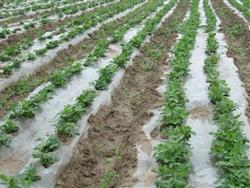
Pod sowing with film mulching is an effective measure for early sowing of spring peanuts by borrowing soil moisture, ensuring full stands, resisting drought and increasing yield. The Agricultural Technology Extension Center of Linmu County began trials and demonstrations in 1987, and from 1992 to 1993 the implemented area reached 8,520 hectares, with average unit yields reaching 3,982.5 kg/ha and 4,057.5 kg/ha, increases of 13.9% and 16.1%. In the past three years the extension area has been around 10,000 hectares each year, driving the county's 18,000 hectares of peanuts to exceed the 4,500 kg/ha mark in average unit yield for three consecutive years, and plots with large-area unit yields of 7,500 kg/ha have emerged.
I. Main yield-increasing mechanisms of peanut pod sowing with film mulching
Through many years of trials, demonstrations and extension of peanut pod sowing with film mulching in Linmu County, the yield pattern is: in years with abundant rainfall it can stabilize and increase yield, in autumn-drought years the yield increase is relatively large, and in years with severe autumn drought the yield increase is even greater. Generally, compared with kernel-sown film-mulched peanuts, it increases pod yield by 300 kg/ha to 780 kg/ha, an increase of 6.2% to 17.4%; compared with open-field kernel-sown peanuts, it increases pod yield by 988.5 kg/ha to 1,695 kg/ha, an increase of 24.0% to 49.6%. The main yield-increasing mechanisms are:
1. Borrowing moisture for early sowing, achieving a full stand in one sowing. Linmu County normally plants about 18,000 hectares of peanuts, with spring peanuts accounting for more than 80% of the total sown area, mostly grown on hilly dryland. The suitable sowing period is generally mid-to-late April, but this period is often "drought in nine out of ten years," seriously affecting spring sowing and full stands of peanuts. Because of the double protection of the pod shell and plastic film, pod-sown film-mulched peanuts tolerate low temperatures and do not rot, so they can be sown early by borrowing moisture, generally 10 days to 15 days earlier than kernel-sown film-mulched peanuts and 25 days to 30 days earlier than open-field kernel-sown peanuts, with the sowing period advanced to late March to early April. At this time, because temperatures are relatively low, soil moisture evaporation is small and soil moisture conditions are good, which is conducive to achieving a full stand of peanuts in one sowing, with uniform and strong seedlings.
2. Controlling plant growth and resisting lodging. Pod-sown film-mulched peanuts are sown early, when temperatures are low, and throughout the growth period the plants are relatively short, with many branches, short internodes and a compact plant type. When hot and humid weather arrives (mid-to-late July), the peanuts have already entered the pod-setting stage, with an obvious effect of using pods to control vegetative growth, stabilize growth and resist lodging. According to a 1989 sowing-date trial, peanuts sown on April 5 had a main stem height of only 27.5 cm, while the main stem heights of several late-sown treatments were all above 30 cm.
3. Early pod setting and high filled-pod rate. Pod sowing with film mulching can promote the development of the reproductive organs of peanuts, with early flowering, early pod setting and a high filled-pod rate. According to trial investigations: within a certain range, for every 5 days of earlier sowing, effective flowers increase by 2% to 3%, the fertilization rate increases by 7.5% to 9%, the filled-pod rate increases by 3.8% to 7.6%, and the number of pods per kilogram decreases by 72 to 114.
4. Drought resistance, disaster resistance, high and stable yield. The climate of Linmu County is characterized by "drought in nine out of ten springs, drought in eight out of ten autumns." Spring drought makes full stands difficult, and autumn drought prevents pods from filling. Pod-sown film-mulched peanuts borrow moisture in early spring to achieve a full stand, set pods early, and to varying degrees avoid the impact of autumn drought on pod setting. Because sowing is early, the emergence period can avoid spring drought, giving uniform and full stands; because pod setting is early, the pod-setting period can avoid autumn drought, giving many and well-filled pods, so the more severe the autumn drought, the greater the yield increase. Since 1989, in 1990 and 1995 there was no autumn drought and yields increased by about 10%, while in the remaining autumn-drought years yields increased by more than 10%; among these, in 1989, 1992 and 1994 the autumn drought was severe and the yield increases all reached more than 20%.
II. Cultivation techniques for peanut pod sowing with film mulching
1. Deep plowing and land preparation, with three ditches matched. In order to promote the deep development of the peanut root system and improve drought resistance, peanut fields generally adopt deep winter plowing or early spring deep plowing to 30 cm, generally increasing yield by more than 20% compared with conventional shallow plowing of 15 cm to 20 cm. For pod-sown film-mulched peanuts, the pod-setting period is earlier, and if the rainy season has not ended, waterlogging in the field easily causes pod rot. Therefore, the three ditches must be well matched to thoroughly eliminate "half-side waterlogging" and "internal waterlogging," ensuring timely drainage after rain.
2. Applying sufficient base fertilizer and formula fertilization. For pod-sown film-mulched peanuts, the fertilization principle is to apply nitrogen and phosphorus steadily, increase potassium fertilizer and supplement microelement fertilizer. Generally, on the basis of applying sufficient organic fertilizer, apply an average of 75 kg of pure nitrogen per hectare, and 112.5 kg each of phosphorus pentoxide and potassium oxide, with a ratio of 1:1.5:1.5. The fertilization method is to apply all potassium fertilizer together with 2/3 of the nitrogen fertilizer early and deeply in combination with plowing; phosphorus fertilizer and 1/3 of the nitrogen fertilizer are applied in bands when ridging. By increasing fertilizer application and using a reasonable ratio, soil fertility is built up, the soil is improved, and water storage and fertilizer retention capacity are enhanced.
3. Selecting good varieties and treating seeds. Many years of practice have proven that pod-sown film-mulched peanuts have a long growth period, and choosing medium-to-late-maturing large peanuts gives greater yield potential; in autumn-waterlogging years, medium-to-late-maturing varieties have less pod rot and fewer sprouted pods than early-maturing varieties, and the yield increase is greater. Selecting good seed pods is an important technical step in pod sowing with film mulching. Because pod sowing, unlike kernel sowing, cannot directly identify seed quality, before sowing it is necessary to strictly select pods with good color and plump kernels as seed, removing insect-damaged, sprouted, shriveled and late-season pods, and sun-dry the seeds for 2 days to 3 days. Seed treatment should be done well; the method is: first split open double-kernel pods and crack open the opening of single-kernel pods, then soak the seeds for 1 day to 2 days, with the criterion being that the seed kernels are basically soaked through.
4. Timely sowing and increased density. Over the past few years, the sowing period for pod-sown film-mulched peanuts has been suitable from late March to early April, 10 days to 15 days earlier than kernel-sown film-mulched peanuts, with emergence 22 days to 25 days after sowing, and seedlings released from the film after Guyu when frost has ended. According to trials, sowing on April 1 gave an average pod unit yield of 5,550 kg/ha, increasing yield by 310.5 kg/ha and 456 kg/ha compared with sowing 5 days and 10 days later, respectively. Sowing 10 days later reduced yield by 429 kg/ha compared with kernel sowing in the same period. Because pod-sown film-mulched peanuts have a compact and relatively short plant type, planting density should be appropriately increased, generally by about 10% compared with conventional kernel sowing. Press the soil after sowing to prevent seedlings from lifting the shell out of the soil.
5. Preventing diseases and controlling insects, protecting leaves and pods. At sowing, use 7.5 kg of 10% phorate per hectare to cover the seed, ensuring uniform and full stands. In mid-July, use 40% methyl isofenphos 1,000-fold solution to drench the hills, with a 95% effect in controlling white grubs. From early July to early August, spray 40% carbendazim 500-fold solution or Yebanqing 600-fold solution to control leaf spot disease 2 times to 3 times, with a yield-increasing effect of 15.4%. In the later growth stage of peanuts, promptly spray 1% urea and 0.2% potassium dihydrogen phosphate aqueous solution on the leaves 1 time to 2 times, to prolong the functional period of the leaves and promote full and plump pod filling.