Eight Precautions for Film-Mulched Cultivation of Spring Peanuts
Applying film-mulching cultivation technology to peanut production can raise temperature, ensure full stands, retain water and preserve fertilizer, thereby achieving increased yield, higher income and giving a head start on the season. In 2002, our institute conducted a comparative trial of film-mulched cultivation of spring peanuts, obtaining a plot trial yield of 402.75 kg per mu and a field yield of 367....
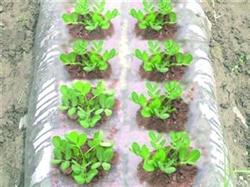
Applying film-mulching cultivation technology to peanut production can raise temperature, ensure full stands, retain water and preserve fertilizer, thereby achieving increased yield, higher income and giving a head start on the season. In 2002, our institute conducted a comparative trial of film-mulched cultivation of spring peanuts, obtaining a plot trial yield of 402.75 kg per mu and a field yield of 367.5 kg, an increase of more than 50 kg over bare ground. The main points to note in film-mulched peanut cultivation technology are summarized below for everyone's reference.
After spring peanuts are covered with plastic film, the ground temperature can rise by 3-4°C. The temperature within the 5-10 cm soil layer can reach 12-13°C 10 days before the last frost, and the sowing date can accordingly be advanced by about 10 days. Therefore, the planting plot should be plowed in the winter of the previous year to expose and whiten the soil, then harrowed and tilled several times to make the soil fine and crumbly. Then the beds should be formed according to the width of the film. The bed surface should be level and the clods fine and crumbly to ensure the quality of film covering.
Planting can be done 10-12 days before the local last frost. In northern Guangdong, sowing is done in the last ten days of the second lunar month; sowing too late makes the film-covering effect insignificant. With mulched planting, fertilizer use efficiency is high and plants grow vigorously; planting density should be determined according to variety characteristics and soil fertility. Spacing can be 20 cm × 26 cm or 23 cm × 26 cm, with 0.95-1.0 ten thousand hills per mu and two seeds per hill.
Cover with film immediately after planting. For ease of cutting the film and for warming, white film of 0.015-0.018 mm can be selected; when it exceeds 0.02 mm, the pegs find it difficult to penetrate the film and enter the soil. To save costs, disposable white transparent ultra-thin film can also be used. When covering, the film should fit tightly against the soil surface with no gaps, and the edges should be pressed firm with soil.
Mulched cultivation involves no intertillage and no topdressing. At the same time, ground temperature rises, microbial activity increases, and organic matter in the soil decomposes quickly. Therefore, the application rate of organic fertilizer should be increased. Per mu, 1000-1500 kg of decomposed farmyard manure can be mixed with 50 kg of high-concentration compound fertilizer, or 100 kg of peanut-specific compound fertilizer plus 1 kg of borax, applied into the soil as base fertilizer together with the first harrowing; in the later growth stage, according to the plant's growth and development, supplementary foliar fertilization can be used, spraying 0.2% urea solution together with monopotassium phosphate and trace elements on the leaves.
For pre-emergence herbicide, 100-150 ml of 50% butachlor (or 50% acetochlor) or 100 ml of 72% Dual can be sprayed on the bed surface per mu after sowing. If weeds have already grown on the bed surface, an appropriate amount of non-selective herbicide (glyphosate, Roundup, Gramoxone) can be mixed in to kill the weeds. The dosage of pre-emergence herbicide should not be too high; otherwise the emerging seedling leaves will curl at the edges, be small and yellow, and the root system will be thin and weak with few and small nodules, seriously affecting plant growth.
Because rainwater finds it difficult to enter the soil to replenish moisture after film covering, if the soil is too dry at sowing, seeds may dry out, emergence will be slow, growth uneven and seedlings missing; but if the moisture content is too high, poor soil aeration will impede seed respiration, causing seed suffocation and rot and resulting in missing seedlings. The suitable soil moisture at sowing is when soil squeezed tightly in the hand forms a ball and crumbles as soon as the hand is released. During the growing season, if cloudy weather occurs, the ditches should be cleared in time for drainage to prevent root rot, pod rot and the spread of plant diseases; in drought, irrigation should use furrow irrigation and soaking (flood irrigation must not be used).
After film covering, the temperature under the film on sunny days can reach as high as 50°C. When the cotyledons are found breaking through the surface soil 7-10 days after peanut sowing, the film should be cut in time to guide the seedlings out, preventing the seedlings from being scorched or baked to death and ensuring the first pair of lateral branches emerges. The timing of film cutting should be after the cotyledons arch through the surface soil and before the third true leaf unfolds, and the earlier the better. The method is to lightly cut a small opening with a blade where the cotyledons emerge, just enough to guide the seedlings out. If the opening is too large, the surrounding area should be pressed firm with clods of soil to ensure the film-covering effect.
Peanut plants under film-mulched cultivation grow vigorously and have relatively strong resistance to pathogens, but after film covering, because ground temperature rises, the activity period of underground pests (cutworms, mole crickets, etc.) is correspondingly advanced, and the activity of rhizosphere pathogens is also enhanced. When pesticides are sprayed, pests hide under the film, bringing certain difficulty to control work. For control, consider seed dressing with thiophanate-methyl, spreading granular pesticides (carbofuran, isofenphos-methyl, etc.) into the planting furrow at sowing; when spraying, choose pesticides with systemic, contact and stomach-poison action, or choose biological pesticides for control.
Peanut plants under film-mulched cultivation grow and develop faster, and in the later stage are prone to excessive growth and lodging, which affects yield. Therefore, 20-25 days after the beginning of flowering, when the plants close the rows (main stem of Spanish-type peanuts with 12-13 leaves), growth should be controlled in time. B9 at 800 ppm or 15% paclobutrazol at 50 g per mu diluted in 50 kg of water can be sprayed to control growth.
Through film-mulched cultivation, the maturity period of peanuts can be advanced by 7-10 days. If not harvested in time, pod drop or germination in the soil may occur and affect yield. Harvest should be done on a sunny day when the lower leaves have fallen, the upper leaves have turned yellow, and the nyctinastic movement of the leaves has disappeared; after harvest, the plastic film should be collected and centrally disposed of in time, so as not to affect the growth of the following crop and cause environmental pollution.