Identification Methods for Late Blight and Gray Mold in Greenhouse Tomatoes
Late blight and gray mold are important diseases that severely affect the yield and output value of spring-season greenhouse tomatoes in northern China. Early detection and accurate identification are the prerequisites for effective prevention and control. Their field symptoms often vary with cultivar and environmental conditions, and are easily confused with each other or with other diseases, causing confusion for growers. The following is an introduction to the...
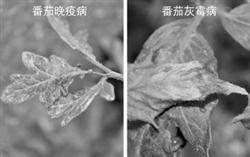
Late blight and gray mold are important diseases that severely affect the yield and output value of spring-season greenhouse tomatoes in northern China. Early detection and accurate identification are the prerequisites for effective prevention and control. Their field symptoms often vary with cultivar and environmental conditions, and are easily confused with each other or with other diseases, causing confusion for growers. The symptom characteristics of the two diseases and points to note during identification are introduced below, in the hope of being helpful to growers.
Late Blight
Symptoms: The disease can affect leaves, stems and fruits throughout the entire growth period, with leaves and green fruits suffering most severely. In seedlings, the disease generally starts with dark green water-soaked lesions on the leaves, then spreads to the stem, with dark brown rot near the leaf petiole; as the disease progresses, the base of the young stem becomes water-soaked and constricted, and the plant wilts and topples over. In adult plants, the disease starts from the lower leaves and develops upward, with dark green water-soaked lesions (resembling scalding) appearing first at the leaf tips and margins, gradually turning brown; in severe cases, the leaves of the entire plant dry up. Stem lesions are brown or dark brown, water-soaked and slightly sunken. Fruit lesions are initially oily dark green, gradually turning dark brown to brownish (yellow), with a cloud-patterned appearance, rough and hardened. Under humid conditions, white mold layers can be produced on all affected parts.
Points to note: (1) Sometimes leaf lesions are V-shaped from the leaf tip, or when conditions are unsuitable the affected parts dry up and no mold layer is visible; when only leaves are affected, it is easily confused with gray mold. (2) When environmental conditions are particularly favorable, the disease develops rapidly, with no obvious lesions on the leaves but conspicuous white mold. (3) When only leaves are affected, it is easily confused with frost damage, but frost damage occurs on the upper leaves. (4) Improper fertilization can also cause leaf drying similar to late blight, which also starts from the lower leaves, but is evenly distributed throughout the field.
Gray Mold
Symptoms: Leaves, stems, flowers and fruits can all be infected, with fruits, especially green fruits, suffering more severely. Fruit infection usually starts from the petals, receptacles and stigmas remaining on the green fruit, then spreads to the fruit and pedicel; the fruit skin becomes grayish-white, water-soaked and soft-rotted, and affected fruits generally become mummified and do not drop off. Leaf infection usually starts from the leaf tip or margin, spreading inward in a "V" shape, with yellowish-brown lesions that have alternating light and dark concentric rings or no rings. Stem infection begins as small water-soaked spots, then develops into long elliptical or irregular shapes. Under humid conditions, a grayish-brown mold layer appears on the surface of all affected parts.
Points to note: (1) In recent years, an atypical symptom called "ghost face spot" is often seen, in which round spots with white outer edges and green centers, 3-10 mm in diameter, appear on the fruit; it occurs more frequently in foreign hard-skinned tomato cultivars and is easily confused with fruit affected by canker and scab. (2) Leaf lesions vary, being V-shaped, nearly round, irregular, etc., with or without concentric rings. (3) Generally, a mold layer is easily produced after infection, but sometimes no mold layer is visible.
Making a preliminary diagnosis based on field symptoms, distribution, and factors such as weather and water and fertilizer management can help with emergency control, but due to the diversity and complexity of symptom expression, when necessary, professional personnel should be asked to perform indoor microscopic examination for confirmation, and then the prevention and control measures should be revised.