Detailed Explanation of Spring Cauliflower and Pumpkin Intercropping Cultivation Techniques
In spring, when it is time to train the pumpkins grown in arch sheds onto trellises, many vegetable growers choose single-line trellising. Single-line trellising simply means hanging the two vines of the pumpkin side by side, which makes trellising faster. However, because pumpkin leaves are relatively large, the vines already look crowded as soon as the fruit begins to set, which is unfavorable for pumpkin coloration. Vegetable growers in Jitai Town, Shouguang City, Shandong Province...
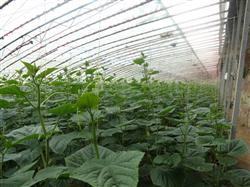 Pumpkin is a vegetable with high nutritional value and is welcomed by people because it has both edible and health-care benefits. During pumpkin cultivation, the early stage leaves a large amount of unused space in the field, resulting in waste of land, light, and heat resources. We adopted intercropping cultivation of cauliflower and pumpkin, which requires low investment, has simple and easy methods, and gives high economic returns. It has been demonstrated and promoted in suburban vegetable-growing areas and is generally welcomed by farmers.
1. Intercropping strips. Every 3.3 m forms one intercropping strip, evenly divided into 3 beds, with each bed 1.1 m wide. Before planting, open furrows and make beds; the furrow is 45 cm wide and 15 cm deep. Apply sufficient farmyard manure, and add 25-30 kg of N, P, K compound fertilizer per mu. Plant 2 beds of cauliflower, with 2 rows per bed, and leave 1 bed to later plant 1 row of pumpkin. All are covered with small arch sheds.
2. Variety selection and seedling raising. Cauliflower is cultivated out of season in spring. Through trials, most varieties showed early curd formation, small curds, fuzziness, and rapid bolting. Huayu Big Cauliflower 80 days showed white, firm curds and good market quality. Sow and raise seedlings in a sunny seedbed in mid-December. First wet the seedbed, then evenly sow the seeds, sowing 10 g of seed per 6 sq m, and cover with 0.5 cm of fine soil. At night, add straw mats over the shed film of the sunny seedbed to keep warm. In the later period, pay attention to ventilating and cooling, and reducing moisture to cultivate strong seedlings.
For pumpkin, Changmian No. 2 can be selected. It is a first-generation hybrid variety, grows and develops quickly, and is resistant to the three major diseases of downy mildew, virus, and powdery mildew. Raise seedlings in early February in early spring. First soak the seeds in warm water at 30°C for 4-5 hours, remove them, spread them on a wet towel, roll it up, and place it in an incubator, adjusting the temperature to 32°C for germination. Generally, after 24-26 hours, the shells crack and sprouts emerge. Most farmers use a soil heat-insulation box for germination. The method is: roll the seeds in a wet towel, place them in a cardboard box with length, width, and height of 40 cm x 30 cm x 40 cm, then suspend a 25W light bulb inside, insert a thermometer at the same time, wrap the outside with a cotton pad for insulation, and control the temperature at about 32°C for germination. Pick out the germinated seeds and place them in prepared nutrient pots, 1 seed per pot, cover with 1-1.5 cm of nutrient soil, and place them in a greenhouse or sunny seedbed. The daytime temperature should reach above 25°C, and the nighttime temperature should not be lower than 5°C. Continue germinating the seeds that have not sprouted. Be careful to prevent mice from digging up and eating them. After emergence, water the nutrient pots promptly, and pay attention to ventilating and cooling to cultivate strong seedlings.
2. Planting and management. The planting time for spring cauliflower is generally around February 25, with a seedling age of about 70 days and 4-5 true leaves. Before planting, spray the seedbed with an antibacterial agent to control seedling rot. 50% chlorothalonil or metalaxyl-copper can be selected. The wide row is 65 cm, the narrow row is 45 cm, the plant spacing is 45 cm, and 2690 plants are planted per mu (effective area), with 2 rows per arch, covering with the arch shed as planting proceeds. In March, sunlight is sufficient, so ventilate and cool at any time so that the temperature inside the arch shed does not exceed 28°C. When the cauliflower grows to the size of a small basin mouth, remove the covering, which can be done in the latter half of the afternoon or on cloudy days. Cauliflower has a high fertilizer requirement. After planting, generally topdress 2-3 times, either by flushing with human manure and urine or by applying 20 kg of urea per mu. The main insect pests are cabbage caterpillars and diamondback moths, which can be controlled with biological pesticides such as diflubenzuron and abamectin to produce pollution-free cauliflower.
The pumpkin seedling period is about 35 days. When it grows to 4-5 leaves, it can be planted, around March 10. The plant spacing is 53 cm, single row, with 380 plants per mu, and immediately after planting, cover with a small arch shed. When most of the vines grow to touch the small arch shed, the arch shed can be removed. Press the vines 2-3 times and remove the branches. After the first female flower opens, hand pollination should be carried out from 7-9 a.m. The method is: gently smear the stamens covered with pollen onto the stigma of the female flower. Each male flower can pollinate 4-6 female flowers. Because it is a first-generation hybrid, fruit setting is neat and uniform. After the first fruit is set, retain the branches so that both the main stem and the branches set fruit. There is also no need to carry out hand pollination again. During the pumpkin seedling stage, it is susceptible to melon aphids, which can be controlled with 10% imidacloprid or abamectin. Other insect pests occur less, making it easy to produce pollution-free vegetables. Each time a batch of pumpkins is harvested, apply fertilizer once, either by flushing with human manure or N, P, K compound fertilizer.
4. Harvest and benefits. The harvest time for cauliflower is around May 1. Five days before harvest, bend the leaves to cover the curd so that the curd is white and easy to sell. When the base of the curd feels slightly raised by hand and the outer leaves of the plant clearly spread open, it is the suitable harvest period. The single curd weight is 1-1.5 kg, and the benefit per mu based on the intercropping area is 1500-1800 yuan. Cauliflower is harvested multiple times. After each harvest, promptly remove the residue to free up space for the pumpkin until harvesting is completed.
For pumpkin, harvesting young pumpkins for market is more profitable, and part of the old pumpkins can also be harvested. When the outer skin of the young pumpkin changes from bright green to dark ink green, it is the suitable harvest period, generally around May 20, which can be 35 days earlier than open-field cultivation. The single fruit weight is 2-2.5 kg. It tastes delicious when stir-fried, better than zucchini, and is very popular in the market. When the first fruit grows to about 1 kg, the second fruit begins to set. Including fruits set on branches, during the peak fruiting period each plant can set 3-5 fruits, and the harvest period can generally last until early November. The yield per mu can reach 5000-6000 kg, with a benefit of 3000-3500 yuan.