Techniques for Skillfully Trellising Pumpkins in Spring Polytunnel
Spring open-field cultivation techniques 1. Sowing and seedling raising: The pumpkin varieties introduced above belong to the Western pumpkin type, and for spring cultivation early sowing is suitable; the sowing date can be calculated back from the planting time. For example, in the Jianghuai region, planting can be done in mid-to-late April, and counting on a seedling age of 30 days, sowing should be done in mid-to-late March. If a specific time is needed...
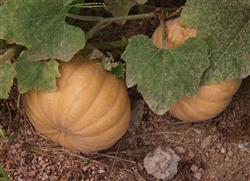 When the time comes to trellis spring polytunnel pumpkins, many vegetable growers choose the single-line trellising method. Single-line trellising simply means hanging the pumpkin's two vines side by side, which makes trellising faster. However, because pumpkin leaves are relatively large, the vines already look very crowded as soon as fruiting begins, which is not good for pumpkin coloring. Inspired by sweet pepper trellising methods, vegetable growers in Jitai Town, Shouguang City, Shandong Province, worked out a trellising method that can promote pumpkin coloring.
For sweet peppers, a trellising method with 3 hanging strings across two rows is generally chosen, so that the spread of the hanging strings allows the 4 main branches of the sweet pepper to open naturally and prevents the interior of the plant from becoming too closed and shaded. Inspired by this, the local vegetable growers did not add more hanging strings, but still used one hanging string per row, using the tightness of the hanging string to control the direction of the two main vines. The specific method: when trellising, hang vines that have not yet set fruit more loosely, and hang vines that have already set fruit more tightly. By using the tightness of the hanging strings, the pumpkin's two vines are naturally divided into two rows spaced 30-50 cm front to back. After the pumpkin sets fruit, leave 10 leaves and pinch off the growing tip. Trellising should start from the vine below the fruit, keeping the pumpkin 2-3 cm above the ground, and the vine after the two leaves above the fruit can hang down naturally.
This trellising method can not only avoid the vines becoming too closed and shaded and increase the plant's light-receiving area, but also naturally divide them into two rows, making farm operations such as hand pollination more convenient. The vine after the two leaves above the fruit hanging down naturally also reduces the load on the hanging string. Vegetable growers who plant pumpkins may as well try this method.