Detailed Key Points of Spring Cultivation Techniques for Mini Pumpkins
I. Timely Sowing: For greenhouse cultivation, sow in spring from mid-January to early February, with a seedling age of 20-25 days; for low-tunnel open-field cultivation, sow in mid-to-late February, with a seedling age of 20-25 days, and transplant into low tunnels in early-to-mid March. II. Seed Treatment and Sowing: Soak pumpkin seeds in clean water for 3-4 hours, then soak in a 500-fold dilution of 50% carbendazim...
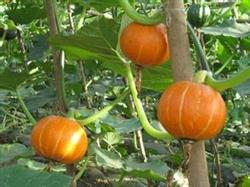
I. Timely Sowing: For greenhouse cultivation, sow in spring from mid-January to early February, with a seedling age of 20-25 days; for low-tunnel open-field cultivation, sow in mid-to-late February, with a seedling age of 20-25 days, and transplant into low tunnels in early-to-mid March.
II. Seed Treatment and Sowing: Soak pumpkin seeds in clean water for 3-4 hours, then soak in a 500-fold dilution of 50% carbendazim for 2 hours, rinse clean, germinate at 25-30°C for 24-48 hours, and sow in a heated seedbed.
III. Seedling Stage Management: The temperature before emergence should be 25-30°C during the day and 15-20°C at night; after emergence, 20-25°C during the day and around 15°C at night. Transplant when 3-4 true leaves have unfolded. 7-10 days before transplanting, move the seedling pots once to harden the seedlings and enhance stress resistance. Prevent high temperatures during seedling raising; keep the tunnel temperature below 30°C. On sunny days with high temperatures, prevent seedling scorching. On cloudy and rainy days, ventilate to reduce humidity and keep the seedbed moisture at an appropriate level.
Do not apply topdressing during the seedling stage. Combined with disease prevention, spray a mixture of a 500-fold dilution of carbendazim or chlorothalonil and a high-quality compound foliar fertilizer once a week.
IV. Land Preparation and Transplanting: For trellis cultivation, make beds 80-100 cm wide with a plant spacing of 30-35 cm, planting 1 row per bed. For low-tunnel open-field cultivation with single-row ground trailing, make beds 3 m wide. Apply 80 kg of bio-organic compound fertilizer or 1000-2000 kg of decomposed organic fertilizer per mu. Plant 800-1000 plants per mu, transplant with roots protected, and water immediately after planting to settle the roots.
V. Field Management:
1. Fertilizer and Water: Pumpkins have a strong capacity for absorbing nutrients. Nitrogen fertilizer should be controlled in the early stage, and sufficient topdressing should be applied during the fruit development and swelling stage. The first application is 10-14 days after transplanting, applying 5-6 kg of ternary compound fertilizer per mu in holes. After application, cover with soil and water. The second application is during the fruit swelling stage, applying 20-25 kg of ternary compound fertilizer plus 5 kg of potassium fertilizer per mu. After application, earth up and water. Thereafter, apply topdressing according to plant growth and fruit set.
2. Vine Tying and Trellising: Tie and guide vines onto the trellis to make full use of space, improve light exposure, facilitate close planting, and increase yield. For ground-trailing cultivation, it is advisable to build low trellises and guide the vines up so that the fruits hang and receive full light for even coloring.
3. Flowering and Fruiting Habits and Pruning Methods: Mini pumpkins are monoecious with unisexual flowers, and female flowers appear relatively early on the main vine. For greenhouse single-vine pruning, fruit set begins from the 3rd-4th female flower above the 10th node; pollinate 3-4 female flowers consecutively, and retain 2-3 fruits per plant. For low-tunnel open-field ground-trailing cultivation, use double-vine or multi-vine pruning, and retain 4-5 fruits per plant.
4. Flower and Fruit Retention: In the low-temperature season of early spring, excessive pre-flowering fertilizer and water often leads to excessive vegetative growth, insufficient nutrients for flowers and fruits, and rainy weather during the flowering period affects pollination, or female flowers open early with no male flowers for pollination, causing flower and fruit drop. Therefore, artificial pollination should be carried out from 8-10 AM during the flowering period. You can also use a 800-fold dilution of Baoguoning No. 2, a 500-fold dilution of 2.2% 4-CPA, or a 1200-fold dilution of 20% phenylacetic acid; spray or apply to the stigma of flowers opening on the same day to promote fruit set.
5. Pest and Disease Control: For powdery mildew, spray a 2000-3000-fold dilution of 12.5% myclobutanil. For Fusarium wilt, mix 10 g of Anke Mancozeb with 70% alcohol into a paste and smear it on the stem. For whiteflies, use fipronil or abamectin; for leafminers, use Qianke.
VI. Harvest: In spring, harvest the first fruit about 30 days after pollination to promote full swelling of the 2nd and 3rd fruits and help increase yield.