How to grow spring peanuts for high yield? Mulch covering is the key
In Maoming City, promoting mulch-covered cultivation of spring peanuts allows planting half a month to a month earlier, extends the peanut growing period, and increases yield by 20%-30% compared with ordinary open-field cultivation of spring peanuts. When cultivating with mulch, focus on the following steps: 1. Sow early to extend the growing period. Mulch-cultivated spring peanuts can be planted earlier...
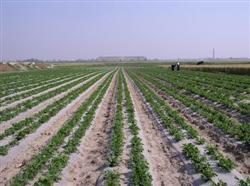 When planting spring peanuts, using mulch-covered cultivation technology has the advantages of earlier sowing, warming and moisture preservation, weed suppression, protection against low-temperature damage from late spring cold, promotion of peanut growth and development, earlier market listing, increased returns, and a higher rate of full pods. It can both increase yield and improve quality. In order to better promote peanut mulch-covered cultivation technology and achieve high quality and high efficiency in peanuts, the key techniques for sowing peanuts under mulch are introduced as follows:
1. Make good pre-sowing preparations
1. Variety selection. Good seed is the key to ensuring full stands and strong seedlings in one sowing, and it is an economically effective measure to increase yield and improve quality. For peanut varieties, choose high-yield varieties with great yield potential and good market quality, such as Jihua No. 4, Jihua No. 5, Jihua No. 2, and Luhua 14.
2. Seed treatment. Peanut seed is generally best shelled about 10 days before sowing; shelling too early or too late is unfavorable for seed germination and emergence. Sunning the seed for 2-3 days before shelling can kill pathogens and effectively increase the seed germination rate.
3. Field tillage and preparation. Choose sandy loam or medium loam fields with medium fertility and good drainage and irrigation conditions. During land preparation, apply 1.5-2 kg of phoxim per mu, mix with 0.5 kg of water and 20 kg of fine soil, and apply evenly into the soil to control overwintering white grubs. To ensure mulch quality, during land preparation carry out shallow plowing and fine harrowing 2-3 times to achieve level land, loose on top and firm below, with no visible or hidden clods.
4. Formula fertilization. In combination with land preparation, apply more than 3 cubic meters of coarse manure per mu, 40 kg of superphosphate, 15 kg of potassium fertilizer, and 500 g of large-granule boron, or 50 kg of 45% special high-quality compound fertilizer and 500 g of large-granule boron, evenly into the soil.
5. Choose good mulch. Use ultra-thin film with a thickness of 0.05 mm for the mulch, at about 3.5 kg per mu.
2. Sowing and mulching techniques
1. Sowing time. In determining sowing time, a stable 5 cm soil temperature above 12°C should be taken as an important basis for sowing peanuts under mulch. In Gaoyang County, the sowing period for spring mulched peanuts is around April 20.
2. Sowing rate. Seed rate per mu: about 25 kg of large and medium unshelled peanuts (equivalent to about 16 kg of peanut kernels).
3. Sowing method. Appropriate close planting is the foundation and guarantee for high peanut yield. Sow in wide and narrow rows, with narrow row spacing of 30 cm, wide row spacing of 55-60 cm, and hill spacing of 18 cm. Use hill sowing, with 2 seeds per hill and a sowing depth of 3 cm. Ensure a density of 8,000-9,000 hills per mu.
4. Weed control after sowing. After sowing and before covering with mulch, apply 100-150 g of 50% acetochlor herbicide per mu mixed with 50-60 kg of water, and spray evenly.
5. Lay the mulch flat. When covering with mulch by hand, be sure to pull it straight and tight, and press the edges firmly with soil all around; when covering with mulch by machine, ensure the mulching quality. If there are holes in the film, press them firmly with soil to prevent strong winds from lifting the film, so as to accelerate the increase of soil temperature and promote early and full emergence of seedlings.
6. Break the film to release seedlings. Generally, peanuts will emerge successively 10-15 days after sowing. When the cotyledons emerge from the soil and open, or when the cotyledons have not emerged but true leaves are visible, use a finger or blade to make a small cross-shaped opening in the mulch directly over the seedling, guide the seedling out of the film, and then seal the opening tightly with fine soil to prevent moisture loss. When making openings to release seedlings, listen to and watch the weather forecast. If the outside temperature is relatively high, breaking the film to release seedlings should not be too late, and especially prevent high temperatures inside the film under strong sunlight from burning the seedlings.