Detailed Guide to Early-Maturing Spring Cultivation Techniques for Japanese Pumpkin
Japanese pumpkin, also known as Western pumpkin, is a new type of vegetable pumpkin introduced in recent years from Japan, South Korea and other places as a high-quality pumpkin. This pumpkin has firm, fine flesh that is sticky or mealy, with excellent flavor, and the fruit is relatively small; when harvested as a vegetable, a single fruit generally weighs 1 kg. It is early-maturing with stable fruit set...
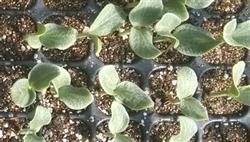
Japanese pumpkin, also known as Western pumpkin, is a new type of vegetable pumpkin introduced in recent years from Japan, South Korea and other places as a high-quality pumpkin. This pumpkin has firm, fine flesh that is sticky or mealy, with excellent flavor, and the fruit is relatively small; when harvested as a vegetable, a single fruit generally weighs 1 kg. It is early-maturing with stable fruit set, and is a major vegetable type for greenhouse facility cultivation.
I. Environmental Requirements for the Growth and Development of Japanese Pumpkin
Japanese pumpkin is a warm-season crop, with a growing temperature of around 25-28°C, and its tolerance to high temperatures is inferior to that of ordinary pumpkin. At a high temperature of 32°C, growth is poor. Japanese pumpkin has good tolerance to low temperatures, and the lowest temperature for growth and development is 6-8°C. It can flower normally at 15°C. However, above 38°C these pumpkins cannot flower and develop normally.
The pumpkin root system is well developed, forming an extensive root mass in the later growth stage; the main root can reach 100 cm deep, and most roots are distributed at around 15 cm. Pumpkin is a short-day crop, and lower temperatures and short days can promote the production of female flowers. Generally in spring, early sowing can lead to early flowering; for most varieties sown in spring, female flowers can open at around the 13th-14th node of the main vine. Japanese pumpkin has relatively high light requirements; under weak light conditions, the leaves turn pale yellow and fruit abortion often occurs, so attention should be paid to this.
II. Cultivation Techniques
1. Variety Requirements
Japan's Huibishou, Taiwan's Dongsheng, South Korea's Jinyuan, Shanghai's Tianfu, Hunan's Jinli, Zhejiang's Ganli, etc.
2. Sowing and Seedling Raising
For cultivation in greenhouses in the Yangtze River Basin, sowing can generally begin in late December, with planting in February. For small-arch-tunnel cultivation, sowing can be done from late January to early February, with planting at the end of March. Before sowing, soak the seeds for 24 hours, then germinate them. During germination, cover the seeds with a wet towel and place them in a hotbed at 25-28°C; on the third day, when the sprouts are 3-4 mm long, sow them into previously prepared seedling pots (10-12 cm diameter). Alternatively, after soaking, sow directly into seedling pots and raise the seedlings in a hotbed. Control the seedbed temperature at around 25-28°C, then cover with a small arch tunnel to retain heat and moisture to promote uniform emergence. After emergence, gradually lower the temperature to 20-25°C during the day and 15°C at night. When the seedlings have 2-3 true leaves, increase the spacing between pots to prevent crowding and leggy growth; at this time the seedlings enter the flower bud differentiation stage, and if covered with shade netting from 16:00 to 8:00 the next day, the node position of female flower formation can be lowered. The seedling age is 40-45 days, and planting is done when the seedlings have 4-5 true leaves.
3. Land Preparation and Base Fertilizer Application
Complete land preparation 7-10 days before planting. For each standard greenhouse, apply 600 kg of decomposed organic fertilizer plus 25 kg of (15-15-15) NPK compound fertilizer as base fertilizer, then make beds. Generally make beds with 120 cm wide beds and 60 cm wide walking furrows. Make three beds per greenhouse, lay out drip lines and plastic film in advance, and cover with small arch tunnels to wait for the soil temperature to rise.
4. Planting
Before planting, treat the seedbed once with 75% chlorothalonil or 70% mancozeb, and place 4-5 granules of NPK compound fertilizer in each nutrient pot, so as to plant with fertilizer and pesticide. For trellis cultivation, generally plant 2 rows per bed with a plant spacing of 50 cm; each standard greenhouse can accommodate 300-400 plants.
5. Field Management
(1) Temperature Management
Generally within 7 days after planting, keep the small arch tunnel sealed to raise temperature and promote seedling establishment. After the seedlings recover, maintain 25-28°C during the day and 15-18°C at night. When above 32°C, ventilate to cool down.
(2) Plant Training
Set up trellises when the vines are 60 cm long. Use upright orchid-style trellises or inverted-V trellises, and cross-training of vines onto the trellis is recommended. Prune in a timely manner, with the method depending on density; some keep one vine per plant, others keep one main vine and one side vine. Generally leave 3 fruits per plant, and pinch the growing tip after leaving 8 leaves above the topmost fruit. In addition, around the harvest of the first fruit, remove the old leaves at the base of the plant to improve ventilation and light penetration and reduce disease.
(3) Fertilizer and Water Management
In the early growth stage, aside from applying a root-promoting fertilizer at planting (1% urea solution or 10% decomposed manure), no additional topdressing is applied. After the first fruit sets firmly, topdress promptly at 7 kg per standard greenhouse. After harvesting the first fruit, apply 3-5 kg of compound fertilizer, and thereafter fertilize as conditions require.
(4) Promoting Fruit Set
Generally, artificial supplementary pollination is carried out. Pollinate in the morning when the sun comes out and the male flowers can shed pollen. In early spring, 0.004% 4-CPA (fruit-setting hormone) can also be used to promote fruit set.
(5) Pest and Disease Control
The main diseases of Japanese pumpkin are damping-off in the early stage, and in the adult plant stage there are viral diseases, sclerotinia rot and powdery mildew, etc. The main insect pests are aphids, thrips, red spider mites, cutworms, etc. Control should be carried out promptly.
6. Harvest
Pumpkin generally needs a certain period of growth and development after fruit set to accumulate enough sugar and express its quality characteristics. In addition, the harvest period should also take into account market conditions, the growth state of the plants, etc., in order to achieve better economic returns.