Key Techniques for Spring Greenhouse Cultivation of Winter Squash (Western Pumpkin)
1. Varieties: At present there are many varieties of Western pumpkin. According to the results of comparative trials of introduced varieties at our institute, the "Dongsheng" and "Yipin" selected by Taiwan Nung You Seed Co., Ltd.; and the "Juhong" series and "Lübao" selected by Jiangsu Chia Tai Seed Co., Ltd. of Thailand's Chia Tai Group "...
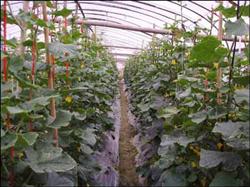
1. Varieties
At present there are many varieties of Western pumpkin. According to the results of comparative trials of introduced varieties at our institute, the "Dongsheng" and "Yipin" selected by Taiwan Nung You Seed Co., Ltd.; and the "Juhong" series and "Lübao" selected by Jiangsu Chia Tai Seed Co., Ltd. of Thailand's Chia Tai Group, all showed relatively good overall traits. The fruit color of the above varieties is mainly of two types, golden-red and dark green, and corresponding varieties can be selected according to market demand in each locality.
2. Cultivation techniques
(1) Sowing period: Western pumpkin prefers a cool climate and is not heat-tolerant (it is susceptible to viral disease during high-temperature periods). Under spring greenhouse cultivation, the whole growth period is generally about 115 days: 65 days from emergence to flowering, and generally 40-50 days from fruit set to harvest. Based on the trial results and combined with the meteorological data of our locality, it is considered that the optimal sowing period for spring cultivation in greenhouses in the Lishui plain area is from late December to early January.
(2) Raising seedlings: ① Preparation of the seedling shed and seedbed: Use double-layer greenhouses with an added small arched tunnel for seedling raising. Seedbed preparation: generally a 7 m wide greenhouse is divided into four beds, with a seedbed width of 1.2 m and a ditch width of 0.7 m. First level the ground inside the greenhouse, dig a ground trench 1.2 m wide and 0.30 m deep, lay 15 cm thick rice straw in the trench, cover with soil, then lay electric heating wire, cover with soil again, and lay plastic film. ② Preparation of nutrient soil: Use 3 parts paddy soil, 1 part burnt mud ash, and an appropriate amount of calcium-magnesium phosphate fertilizer, mixed thoroughly. The soil moisture content should be about 70%. Determination method: it is suitable when a handful of nutrient soil can be squeezed into a ball in the hand and will naturally crumble apart when released and dropped to the ground. Select 10 cm x 10 cm plastic pots, fill them with nutrient soil, arrange them on the seedbed, then spray with 500-fold carbendazim and wait for sowing. ③ Seed soaking and germination: Western pumpkin seeds have already been disinfected before sale, so no further disinfection is needed. Soak the seeds in clean water for one day, then take them out, drain the water, wrap them in a damp cloth, and place them under constant temperature conditions of 30-32°C to germinate for about 2 days; the seeds can be sown once they show white sprouts. ④ Sowing: On the prepared nutrient pots, use tweezers to make a small hole, place the seed radicle (pointed end) downward into the small hole, one seed per pot. After sowing, cover the seeds with about 1 cm of burnt mud ash, and at the same time spray once with 800-fold thiophanate-methyl, finally cover the nutrient pots with a layer of plastic film and then build a small arched tunnel. ⑤ Seedling stage management: Remove the plastic film 3-5 days after sowing. For spring seedling raising, adopt the temperature management principle of high at the front and low at the back. From sowing to full emergence, keep the temperature inside the greenhouse at about 25°C; if the nighttime temperature is lower than 15°C, heat should be added promptly. From true leaf expansion to the three-leaf stage, keep the temperature at about 20°C; 10 days before transplanting, lower the temperature to harden the seedlings (generally no more heating). Generally no fertilization is needed during the seedling stage. Water management is very important: better dry than wet. Watering should be done on sunny days, preferably around 11 a.m.; never water during rainy days or when affected by cold air. Whether rainy or sunny, the greenhouse should be opened for ventilation: on rainy days at 1-2 p.m.; on sunny days generally open the greenhouse at 9 a.m. and close it before 4 p.m. During the seedling stage, attention should also be paid to the control of damping-off and rhizoctonia rot. The seedling age is 30-35 days.
(3) Field planting: ① Land preparation: Use greenhouse plus plastic film with trellis-type planting. The width of the greenhouse is mostly 7-8 m, divided into 4 beds, with a bed width of 1.0 m and a ditch width of 0.8 m. ② Base fertilizer: Fertilizer is mainly applied as base fertilizer, accounting for about 60%. Open a ditch in the middle of the bed and apply 40 loads of barnyard manure and 50 kg of ammonium bicarbonate, cover with soil and level, then lay 1.2 m wide plastic film and wait for planting. ③ Transplanting: Before field planting, spray the seedbed with 600-fold chlorothalonil, and select disease-free strong seedlings for transplanting. Planting spacing is about 0.5 m between plants and 0.7 m between rows. Use single-row zigzag transplanting. Generally 700 plants per mu. After field planting, water to settle the seedlings, and build a small arched tunnel above.
(4) Management after field planting: ① Topdressing and ventilation for warmth retention: Apply topdressing once 3-4 days after transplanting and once when vines begin to run. After field planting, because the temperature is relatively low, the main focus is on heat preservation, but ventilation and air exchange are still necessary. For specific operations, refer to the seedling greenhouse. ② Pruning: Western pumpkin has strong growth vigor, so the three-vine pruning method is generally used, that is, one main vine with two side vines retained, and other excess side vines and the sub-vines growing from side vines should be removed promptly. ③ Artificial pollination and fruit setting: In early spring cultivation, male flowers are later than female flowers, and there are few male flowers, so artificial supplementary pollination should be adopted, that is, use a brush to pick up some pollen from male flowers and apply it to the stigma of female flowers. Western pumpkin has very good fruit-setting ability, and each node can produce one female flower. Generally, all female flowers within 70 cm from the base of the plant should be removed, with one fruit retained per side vine and two fruits retained on the main vine. Letting the fruit set at positions beyond 70 cm is conducive to the formation of large fruit. ④ Heavy application of fruit-swelling fertilizer: When the fruit develops to the size of an egg, dig a hole 25 cm from the base of the plant and apply 20 kg/mu of compound fertilizer.
(5) Harvesting: About 1 month after pollination and fruit set, when the fruit color changes from light yellow to orange-red, it can be harvested and marketed; at this time the market price is relatively good, but the quality is not the best. It should be harvested when the fruit color is deeper, that is, as mature fruit (about 50 days). Harvesting should generally be carried out on a sunny morning, leaving about 2 cm of the fruit stalk.