Control Methods and Precautions for Mung Bean Leaf Spot Disease
Mung bean leaf spot disease is a serious disease harming mung beans, causing the leaves to dry up, quality to decline, and yield to decrease. Below is an introduction to the symptoms, transmission routes, conditions for onset, and control methods of mung bean leaf spot disease. Symptoms: Mung bean leaf spot disease mainly harms mung beans, with the affected part being the leaves. ...
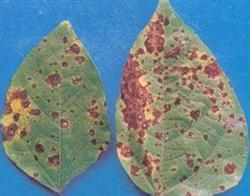
Mung bean leaf spot disease is a serious disease harming mung beans, causing the leaves to dry up, quality to decline, and yield to decrease. Below is an introduction to the symptoms, transmission routes, conditions for onset, and control methods of mung bean leaf spot disease.
Symptoms
Mung bean leaf spot disease mainly harms mung beans, with the affected part being the leaves. Mung beans suffer the most damage during the flowering and pod-setting stage. In the early stage of the disease, water-soaked brown small spots appear on the leaves, which expand to form nearly circular lesions with red-brown to reddish-brown edges and light gray to light brown centers. When humidity is high, dense gray mold layers grow on the lesions, which are the conidiophores and conidia of the pathogen. When the disease is severe, the lesions merge into patches and quickly dry up. In mild cases, yield is reduced by 20%-50%, and in severe cases by as much as 90%.
Transmission Routes
The fungus overwinters as mycelium and conidia in seeds or diseased plant residues, becoming the primary infection source for the following year. During the growing season, it damages the leaves, spreading faster before and after flowering, and spreads through wind and rain.
Conditions for Onset
Under hot and humid conditions, after multiple re-infections by conidia, the pathogen accumulates in large amounts, and once suitable conditions occur, it becomes epidemic. High temperature and high humidity are conducive to the occurrence and spread of this disease, especially in autumn with abundant rain, continuous cropping land, or off-season cultivation, where the disease is severe.
Control Methods
1. Select leaf-spot-resistant varieties such as Qindou No. 4, Qindou No. 6, Zhonglü No. 1, and Luyin No. 1. Select disease-free plants for seed saving, and soak seeds in 45°C warm water for 10 minutes before sowing for disinfection.
2. After harvesting in diseased fields, carry out deep plowing, and implement crop rotation where conditions permit.
3. In the early stage of the disease, spray 50% duomeiwei (carbendazim plus diethofencarb) wettable powder at 1000-1500 times dilution, or 75% chlorothalonil wettable powder at 600 times dilution, 12% lülütong emulsion at 600 times dilution, 80% dasheng M-45 wettable powder at 600 times dilution, 47% jiareinong wettable powder at 800 times dilution, 50% hunshaliu suspension concentrate at 500-600 times dilution, 30% basic copper sulfate suspension concentrate at 400 times dilution, or 1:1:200 Bordeaux mixture, once every 7-10 days, for 2-3 consecutive applications.