How to prevent and control ginger pests and diseases? A full analysis of practical techniques
(1) Ginger blast 1. Pathogen: a bacterial disease, Ralstonia solanacearum. 2. Symptoms of diseased plants: leaves first droop and lose their luster, then turn withered yellow from bottom to top, and finally die. The stem first becomes water-soaked at the base, turns yellow, dies, and breaks off at the base and falls over. The rhizome is water-soaked, turns brown and rots, and when squeezed a white juice flows out with a foul odor.
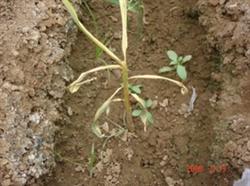
(1) Ginger blast
1. Pathogen: a bacterial disease, Ralstonia solanacearum.
2. Symptoms of diseased plants: leaves first droop and lose their luster, then turn withered yellow from bottom to top, and finally die. The stem first becomes water-soaked at the base, turns yellow, dies, and breaks off at the base and falls over. The rhizome is water-soaked, turns brown and rots, and when squeezed a white juice flows out with a foul odor.
3. Transmission routes and disease patterns: the pathogen overwinters in rhizomes and soil, and survives in soil for more than two years. It invades through wounds or natural openings. The bacterium spreads through seed ginger, soil, fertilizer, and irrigation water.
4. Control methods:
(1). Crop rotation: ginger can only be planted after an interval of more than 3 years, and the previous crop is best a grain crop or scallions and garlic.
(2). Soil disinfection: use 12-15 kg of Longxin per mu, spread it evenly on the soil surface, deep plow, rake level, water, and cover with film. After 20-25 days, remove the film, deep plow, and let the soil air for 10-15 days before sowing.
(3). Strict seed selection: choose ginger rhizomes that are plump, bright in color, fresh in flesh, not shriveled, not rotten, not frost-damaged, firm in texture, and free of pests and diseases as seed ginger. (4). Site selection and land preparation: a sandy loam plot with high, dry terrain and good drainage.
(5). Chemical control:
A. Before sowing, soak the seed ginger in a 300-fold aqueous solution of Kangdileide for 10 minutes, and after arranging the seed, spray the seed ginger and the surrounding soil with a 600-fold aqueous solution of Kangdileide.
B. After full seedling emergence, one month before disease onset, and before and after ridging, apply Kangdileide by drenching once each time, at 1 kg per mu each time.
C. In the early stage of disease, drench the roots of plants at and around the disease center with a 75-fold aqueous solution of Kangdileide or a 300-fold solution of Longkejun or a 400-fold solution of Duoning, using 250 ml of medicinal solution per plant.
(2) Leaf spot disease
1. Pathogen. Deuteromycotina, Phyllosticta zingiberi.
2. Symptoms of diseased plants. It mainly damages leaves. Diseased leaves develop yellow-white spots, and the center of the spots becomes thin and easily perforated, also known as white star disease.
3. Transmission routes and disease conditions. It overwinters as mycelium and pycnidia in diseased residues and soil. It spreads through rainwater, and high temperature and high humidity favor disease onset; dense plant spacing and heavy clay soil lead to severe disease.
4. Control methods: A. Rotation for more than 2-3 years. B. Choose a sandy loam plot with high terrain and convenient drainage and irrigation. C. Balanced fertilization: avoid over-application of nitrogen fertilizer, and emphasize the application of organic fertilizer, phosphorus, potassium, and trace element fertilizers. D. Chemical control: protective agents: Pinrun 800-fold or Xin'erpu 800-fold or Taisheng 800-fold. Therapeutic agents: Baitai 1500-fold or Longkejun 500-fold or Duoning 600-fold. Spray 2-3 times in succession, with an interval of 7-10 days.
(3) Anthracnose 1. Pathogen. Deuteromycotina, Colletotrichum capsici and Colletotrichum gloeosporioides. 2. Symptoms. It mainly affects leaves, first showing water-soaked brown small spots at the leaf tip and leaf margin, then forming elliptical or spindle-shaped brown spots with halos on the spot surface. When humid, small black dots appear on the diseased surface. 3. Transmission routes and disease conditions. It overwinters as mycelium and acervuli in diseased tissue or soil. It spreads through rainwater or small insects. Continuous cropping, high humidity, and over-application of nitrogen fertilizer favor disease onset. 4. Control. A. Rotation. B. Clean the garden after harvest. C. Balanced fertilization. D. Strictly prohibit waterlogging. E. Chemical control: 25% Baoxianke 1000-fold solution, Kaize 1250-fold, Cuibei 4000-fold solution.
(4) Ginger root-knot nematode disease 1. Cause: damage by underground nematodes. 2. Control: (1) Soil treatment: Longxin (same method as for ginger blast). (2) Before ridging ginger, drench the roots with Shuangsha 1000-fold + Abamectin 3000-fold.
(5) Ginger stem borer. Also known as the heart-piercing worm. 1. Symptoms. Larvae invade from the gap between the leaf sheath and stem or from the heart leaf, the leaves become membranous, fecal debris remains at the injured area, and the stem is hollow and easily broken. 2. Living habits and occurrence patterns. There are 2-4 generations per year, and mature larvae overwinter on crops and weeds. Larvae generally begin to appear in early June, with large populations and severe damage in July-August, and they continue to cause damage until the ginger harvest. 3. Control. A. Clean the garden. B. Chemical control: spray 1500-fold Julei solution in early June, spray a second time after 7-10 days, and the solution can also be injected into the stem openings above ground; in early July, spray the same pesticide twice more.
(6) Beet armyworm 1. It has 5 generations per year in Jiaodong. It overwinters as pupae in the soil. 2. Occurrence period: the first-generation larval period occurs in mid-June, the second generation after 20 days, ... 3. Spray before the larvae reach the 3rd instar for control: Chujin 1500-fold, Kasiike 1000-fold.