How to fertilize ginger for high yield? Detailed explanation of the key points of formula fertilization technology
Ginger has a long growing period and a high fertilizer requirement. Under medium fertility conditions, to produce general 2500 kg of ginger per mu, 25-40 kg of nitrogen, 10-22 kg of phosphorus (P2O5), and 30-50 kg of potassium (K2O) need to be applied. The absorption ratio of nitrogen, phosphorus, and potassium is 11:1:16 or 1:0.5:2. In addition, calcium, magnesium, boron, zinc, iron, and other medium and trace...
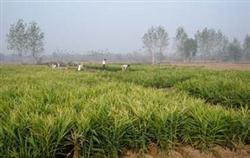
Ginger has a long growing period and a high fertilizer requirement. Under medium fertility conditions, to produce general 2500 kg of ginger per mu, 25-40 kg of nitrogen, 10-22 kg of phosphorus (P2O5), and 30-50 kg of potassium (K2O) need to be applied. The absorption ratio of nitrogen, phosphorus, and potassium is 11:1:16 or 1:0.5:2. In addition, calcium, magnesium, boron, zinc, iron, and other medium and trace elements are also needed. Because the nutrient requirements differ at each stage, only formula fertilization can improve yield and quality.
1. Apply sufficient base fertilizer. Ginger roots are fine and weak and distributed shallowly, so heavy application of base fertilizer is the key to high yield. Before land preparation, broadcast 2500-5000 kg of high-quality decomposed chicken manure per mu. After fertilizing, plow the soil, make beds 1.2 m wide with trenches 30 cm wide and 20 cm deep, and plant 3 rows of ginger; or make beds 2-2.4 m wide with trenches 40 cm wide and 40-50 cm deep, and plant 4-5 rows of ginger. Before sowing, use 75-100 kg of cake fertilizer and 15-20 kg of ternary compound fertilizer per mu, crush them, apply them in a concentrated way into the sowing trenches, and mix them evenly with the soil, then water and sow. In ginger fields lacking zinc or boron, 1-2 kg of zinc sulfate and 0.5-1 kg of borax per mu can be evenly mixed with fine soil or organic fertilizer, applied in the sowing trenches at sowing time, and mixed evenly with the soil.
2. Apply topdressing appropriately. During the ginger growing period, topdressing is generally needed 2-3 times. In ginger fields lacking zinc or boron, 0.05%-0.1% zinc and boron fertilizers should also be sprayed 2-3 times at the seedling stage, the tillering stage, and the rhizome expansion stage respectively.
① The first light application of "strong seedling fertilizer." From leaf unfolding to having 2 relatively large side branches is the seedling stage (that is, the "three-pronged stage"), which takes 65-75 days. During the seedling stage, plant growth is small, but the growing period is long. Usually, the first topdressing is carried out when the seedlings are 25-30 cm tall and have 1-2 branches. Topdressing is mainly nitrogen fertilizer, applying 1000-1500 kg of decomposed human manure or urine per mu or 4-5 kg of urea, applied in furrows or flushed in with water when watering. If sowing is too early and the seedling stage is longer, fertilizer can be applied 2-3 times along with watering, at the same rates as above.
② The second heavy application of "forking fertilizer" (also called "branching fertilizer," "turning-point fertilizer," etc.). From late July to early August around the Beginning of Autumn, when ginger seedlings are in the "three-pronged stage," the demand for fertilizer and water increases, so topdressing should be carried out together with weeding in the ginger field. Generally, cake fertilizer or farmyard manure is combined with quick-acting chemical fertilizer. Apply 1500-2000 kg of decomposed human manure or urine per mu, plus 25-50 kg of ternary compound fertilizer. Open 1 fertilizing trench on one side of the ginger seedlings 15-20 cm from the plant base, scatter the fertilizer in, mix it evenly with the soil, then cover with soil to close the trench and earth up the ridges, and finally water thoroughly. If the weather is dry, irrigate once every 4-6 days and always maintain the relative soil moisture at 75%-80%. Earth up around the plant base 3-5 times to promote rhizome expansion. When ginger seedlings grow to 19.8-23.1 cm tall, remove in time the latent buds growing from the mother ginger to avoid wasting nutrients. When ginger seedlings grow to 35-45 cm tall, one or two more buds grow from both sides of the mother ginger, and these buds should be retained.
③ The third timely application of "expansion fertilizer" (also called "strong ginger fertilizer," "supplementary fertilizer," etc.). From mid-to-late August to early September, when ginger seedlings have 6-8 branches, the third topdressing can be carried out as appropriate. Generally, apply 200-250 kg of decomposed cake fertilizer or 25-30 kg of ternary compound fertilizer per mu. At the same time as fertilizing, use furrow irrigation or watering to prevent root burn. In dry weather, irrigate about once every 10 days; in hot seasons, water in the morning and evening; after heavy rain, drain water immediately so that the bed trenches remain unobstructed. For ginger fields with weak growth or average growth and low soil fertility, quick-acting chemical fertilizers can be topdressed, especially potassium fertilizer and nitrogen fertilizer; for ginger fields with better soil fertility and vigorous plant growth, nitrogen fertilizer should be applied less or not at all. Ginger prefers cool and humid conditions and cannot tolerate high temperature and strong light. In hot weather, build a shed for shade. In early to mid-August, remove the growing tip of the ginger plants once every 7-8 days for 2-3 times in a row; in late August, when the ginger branches and leaves are already luxuriant, the ginger shed can be removed. Water for the last time 3 days before harvest so that the ginger rhizomes can carry moist soil at harvest, which is beneficial for storage. Harvest is usually carried out in mid-to-late October before the first frost arrives.