Field management of winter-planted beans is crucial, and growers should pay close attention to it.
For raising bean seedlings, direct sowing was mostly used in the past; on the basis of fully protecting the roots from cold damage, it ensures uniform and strong seedlings; it allows early sowing, early harvest, and an earlier market launch. In production, nutrient pots are mostly used for raising seedlings, and 50-cell plug trays can also be used, sowing 2~3 seeds per cell, watering thoroughly, and controlling the temperature reasonably. The seedling age is about 25 days...
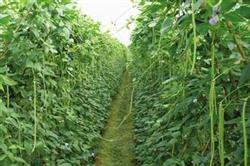
For raising bean seedlings, direct sowing was mostly used in the past; on the basis of fully protecting the roots from cold damage, it ensures uniform and strong seedlings; it allows early sowing, early harvest, and an earlier market launch. In production, nutrient pots are mostly used for raising seedlings, and 50-cell plug trays can also be used, sowing 2~3 seeds per cell, watering thoroughly, and controlling the temperature reasonably. A seedling age of about 25 days is most suitable.
Reasonable close planting: because beans grow under low temperature and weak light during the seedling stage, photosynthesis is hindered and the plant's own nutrients are limited, so planting must not be too dense, to prevent leaves from shading each other. Generally, planting is done in wide and narrow rows (or double high ridges) of 70 cm and 50 cm, with a plant spacing of about 30 cm. After planting, water, then shallow hoe and cover the whole field with plastic film.
Field management: in terms of fertilizer and water management, from transplanting to before flowering, the focus should be on controlling water and promoting root growth through intertillage, and watering should be minimized as much as possible. Before beans flower, apply 15 kg of ammonium sulfate per mu. During the pod-setting period, topdress once every 10~15 days, applying 15~20 kg of ammonium sulfate each time. If conditions permit, after flowering, apply carbon dioxide gas fertilizer every morning on sunny days, and ventilate appropriately 2 hours after application. In the late growth stage of beans, the plants age and the root system deteriorates; to prolong pod setting, spray 0.2% potassium dihydrogen phosphate for foliar fertilization. After the beans begin to vine, set up trellises in time to guide the vines, and also remove side branches and buds in time, trying to avoid leaves shading each other. When the plant height is 2~2.5 m, pinch the growing tips in time to promote pod setting. After each harvest, be careful to remove the lower old leaves.