Key Technical Points for High-Ridge, Sparse-Planting, High-Yield Cultivation of Spring Corn
Many excellent spring corn varieties now require high ridges and sparse planting, but farmers generally adopt low ridges and dense planting, so the superior traits of corn cannot be fully expressed, seriously affecting farmers' income growth. This is especially true for excellent varieties such as Dongdan 60, Sanbei No. 6, Dongdan 13, and Zunyan No. 1, whose planting density per mu must not exceed 3000 plants, while...
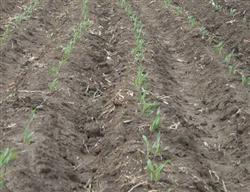
Many excellent spring corn varieties now require high ridges and sparse planting, but farmers generally adopt low ridges and dense planting, so the superior traits of corn cannot be fully expressed, seriously affecting farmers' income growth. This is especially true for excellent varieties such as Dongdan 60, Sanbei No. 6, Dongdan 13, and Zunyan No. 1, whose planting density per mu must not exceed 3000 plants, while most farmers plant more than 3000 plants, even reaching 3500 plants, resulting in wasted land. The high-ridge, high-yield, sparse-planting cultivation techniques for corn are introduced as follows:
I. Variety selection: Choose high-quality, high-yield corn seeds such as Dongdan 60, Sanbei No. 6, Dongdan 13, Zunyan No. 1, and Lianyu 16.
II. Good pre-sowing preparation. 1. Carefully select seeds and determine suitable plots: Mix 20 g of 50% phoxim with 400 g of water to treat 10 kg of seed, stirring evenly to control underground pests.
2. Fine land preparation: For the plot to be sown, harrow and roll repeatedly around the Spring Festival to achieve a loose surface and firm subsoil, so as to preserve subsoil moisture. If moisture is insufficient, open furrows 2-3 days in advance to create moisture, then rake level and wait for sowing.
III. Planting methods. 1. Before sowing, apply 3000 kg of high-quality coarse manure per mu and 15-20 kg of ternary compound fertilizer (16% nitrogen, 16% phosphorus, 16% potassium); sow early when time permits, from May 20 to 25, to achieve full emergence in one sowing; apply pre-emergence herbicide.
2. Dibble sowing holes. Ridge height 25 cm, plant-to-row spacing 0.5 m, leaving 2 plants per hole, with 2500-3000 plants per mu.
3. Thin seedlings at the three-leaf stage, finalize seedlings at the six-leaf stage, and replant missing plants promptly.
4. When corn has 3-5 leaves, spray corn Jindele once, and spray once more at 7-11 leaves. This can make the root system well developed, shorten internodes, and give a good growth-control effect.
5. Apply jointing and booting fertilizer with light application first and heavy application later, and irrigate well for root establishment, booting, and grain filling. At the 4-6 leaf stage, apply 10-15 kg of ammonium sulfate per mu together with watering, and cultivate and hoe weeds by hand. At the 10-12 leaf stage, apply 20-30 kg of urea per mu, and carry out integrated pest control. At this stage, use 2-3 kg per mu of 3% phoxim granules and scatter them into the leaf whorl to control corn borer. A 1500-2000 times dilution of 50% phoxim, 50-100 g, can be used to control the second generation of armyworm.
6. Detasseling alternate rows: Carry this out when the tassel has just emerged from the top, and assist pollination.
7. Prevent waterlogging and drain promptly, and harvest at the proper time.