Key Technical Points for Trellis Cultivation of Winter Melon in Autumn
Adopting the new trellis cultivation technique can make full use of available space, save ground area, raise the multiple cropping index, and increase land output. Autumn planting can fill the market's off-season gap and increase agricultural income. 1. Variety selection. Choose small-fruited varieties such as Guangdong Long Black-Skinned Winter Melon. 2. Planting...
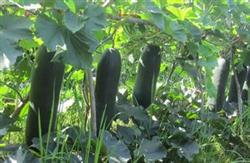
Adopting the new trellis cultivation technique can make full use of available space, save ground area, raise the multiple cropping index, and increase land output. Autumn planting can fill the market's off-season gap and increase agricultural income.
1. Variety selection. Choose small-fruited varieties such as Guangdong Long Black-Skinned Winter Melon.
2. Planting method. Choose fertile, neutral fields with convenient drainage and irrigation. In mid-to-late July, raise seedlings with cooling gauze or film; the seedbed should hold 140-150 plants per sq m, with about 300 g of seed per mu, and the seedling age should be 10-12 days, to prevent heat damage to seedlings or excessive seedling age. For autumn planting, increase the density. For trellis cultivation, plant in single rows with a plant spacing of 80 cm.
3. Land preparation and topdressing. Plow and prepare the land in time, and level, finely break up, and firm the bed surface. Apply sufficient basal fertilizer: 50 kg of compound fertilizer, 1500 kg of decomposed farmyard manure, and 10-15 kg of urea per mu.
4. Field management. Use plastic film mulching to preserve soil moisture and fertilizer. After the autumn-winter melon is transplanted, water 3 times, that is, apply the rooting water, the vine-extension water, and the water at fruit set, to prevent drought. The principle for topdressing late winter melon is "light and dilute early, heavy in the middle, and supplementary in the later stage." After the seedlings are transplanted and established, apply once 100 kg of 20% human manure and urine; when the fruit grows to 4-5 kg, apply 4-5 kg of human manure and urine or 0.1 kg of urea in holes; when the fruit grows to 15-20 kg, apply 5-6 kg of human manure and urine or 0.2 kg of urea in holes. When the vine grows to 1 m long, cultivate once. When the vine is 1 m long, insert bamboo for vine support, remove side vines, and keep the main vine for cultivation. Select and retain normally developed young fruits on nodes 22-26, and hang the fruit when it weighs 3-5 kg.
5. Pest and disease control. Pay attention to controlling damping-off, Phytophthora blight, Fusarium wilt, powdery mildew, anthracnose, aphids, and thrips.