What are the key management points for open-field winter melon during the fruiting period?
Because the fruiting period of open-field winter melon falls in the hot and rainy season, the fruit-setting rate of winter melon is relatively low, and fruit abortion is serious. The following six key points should be mastered in management: 1. Pollination. Winter melon has no parthenocarpic habit, so artificial pollination can greatly increase the fruit-setting rate. The method is to select freshly opened male flowers in the morning, remove the corolla...
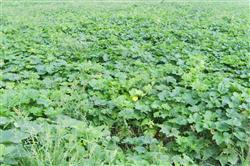
Because the fruiting period of open-field winter melon falls in the hot and rainy season, the fruit-setting rate of winter melon is relatively low, and fruit abortion is serious. The following six key points should be mastered in management:
I. Pollination
Winter melon has no parthenocarpic habit, so artificial pollination can greatly increase the fruit-setting rate. The method is to select freshly opened male flowers in the morning, remove the corolla, expose the anthers, and smear them on the stigma of the female flower, taking care to apply plenty of pollen to the stigma. This should be done before 8 a.m., no later than 10 a.m. A 15-20 mg/kg solution of 2,4-D can also be applied to the flower stalk.
II. Removing side vines
Remove side vines promptly, because each leaf axil of winter melon can produce a side vine, and they grow quickly and consume much nutrition, affecting fruit setting and the development of large fruits, so side vines should generally be removed every other day.
III. Pinching the growing tip
After the winter melon has set fruit, pinch off the growing tip 7-10 leaves ahead of the fruit, so that nutrients can be concentrated to supply the fruit that has already set.
IV. Changing the leader
If the main vine grows excessively due to too much base fertilizer or too much rain and cannot set fruit, the leader can be changed. That is: when a winter melon the size of a peanut grain appears, pinch off the growing tip 1-2 leaves ahead of the fruit. When a side vine grows again from the leaf axil of the top leaf, it can be retained as the main vine. After changing the leader 1-2 times, fruit can be set.
V. Fertilizer and water management
In the early fruiting stage, when the fruit grows to about 250 grams, apply a quick-acting phosphorus and nitrogen fertilizer with irrigation once, applying 7-8 kg each of diammonium phosphate and urea per mu. Entering the harvest period, water once every 15-20 days, and apply chemical fertilizer with the irrigation, applying 7-8 kg each of diammonium phosphate and urea per mu. In the middle fruiting stage, the daily growth is relatively large, and both plant transpiration and soil evaporation are relatively large, so water must be supplied continuously, generally watering once every 7-10 days, with 7-8 kg of potassium sulfate and 5-6 kg of urea per mu applied with the irrigation. In the later stage, watering should be frequent and light, watering once every 5-6 days to keep the soil moist. In the late growth stage of the plants, a foliar fertilizer of 0.2% potassium dihydrogen phosphate plus 0.5% urea aqueous solution can be used to supplement nutrients.
VI. Pest and disease control
The main diseases of winter melon include fusarium wilt and powdery mildew, and the main pest is aphids.
1. Powdery mildew: strengthen cultivation management, water and fertilize reasonably; in the early stage of the disease, use 15% triadimefon wettable powder at 1500 times dilution or 50% sulfur suspension concentrate at 300-400 times dilution, spraying once about every 7 days.
2. Fusarium wilt: practice 3-5 years of crop rotation; carry out soil disinfection; in the early stage of the disease, drench the roots with 50% carbendazim wettable powder at 500 times dilution, 200 ml per plant, once every 10 days, for 2-3 consecutive applications.
3. Aphids: chlorfenapyr, chlorpyrifos, or fenpropathrin can be used, spraying once every 7-10 days, for 2 consecutive sprays.