Detailed Explanation of High-Yield Cultivation Techniques for Green-Skinned Winter Melon
Green-skinned winter melon (wax gourd) is widely cultivated in North China, with strong adaptability, high yield, good storage tolerance, and easy transport. Its high-yield cultivation techniques are introduced as follows. I. Sowing and Seedling Raising 1. Seed treatment. Because winter melon seeds have a relatively thick seed coat and do not absorb water easily, seed soaking for germination and seed disinfection should be carried out before sowing. Use a 50% carbendazim 250-fold solution to soak the seeds for 20 minutes to prevent fusarium wilt and other diseases during the seedling stage...
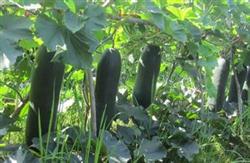
Green-skinned winter melon (wax gourd) is widely cultivated in North China, with strong adaptability, high yield, good storage tolerance, and easy transport. Its high-yield cultivation techniques are introduced as follows.
I. Sowing and Seedling Raising
1. Seed treatment. Because winter melon seeds have a relatively thick seed coat and do not absorb water easily, seed soaking for germination and seed disinfection should be carried out before sowing. Soak the seeds in a 50% carbendazim 250-fold solution for 20 minutes to prevent fusarium wilt and other diseases during the seedling stage. After disinfection, wash the seeds clean with water and then soak them for 5-6 hours. Remove them and carry out germination, with the germination temperature preferably around 30°C.
2. Seedling raising. Sow early at the right time, from the end of January to the beginning of February. After sowing, cover with a plastic film arch shed to protect against cold. When the seedlings grow one true leaf and one heart leaf, transplant them into nutrient bags. The nutrient bag specification is 15×18 cm. For the nutrient soil, use fertile soil that has not previously grown cucurbit crops. After planting, cover again with a plastic film arch shed to protect against cold.
II. Field Planting
1. Land selection. Choose new land that has not previously grown cucurbit crops, or fields that have undergone 3-5 years of paddy-upland rotation for planting.
2. Bed making and land preparation. Make beds with a bed surface of 110-120 cm and a ditch width of 50 cm. There should be a surrounding ditch around the field, with all ditches connected to facilitate irrigation and drainage.
3. Reasonable close planting. When the temperature stabilizes above 15°C, choose a sunny day for transplanting, and remove the nutrient bags at planting. Plant one row per bed, with a plant spacing of 60-70 cm. Plant 450-550 plants per mu, and water with settling water after planting.
III. Fertilizer and Water Management
1. Apply sufficient base fertilizer. Apply the base fertilizer when making beds and preparing land by opening a long ditch in the middle of the bed and burying it. Apply 2000-3000 kg of organic fertilizer and 50 kg of superphosphate per mu.
2. Skillfully apply seedling fertilizer. When the seedlings grow 5-6 true leaves, apply 10-15 kg of ternary compound fertilizer (N, P, K content each 15%) and 8-10 kg of urea per mu. This promotes vine extension, increases the plant's nutrient accumulation, and helps female flower formation and fruit setting. After the first female flower opens, control fertilizer and water to prevent excessive vegetative growth. Preserve flowers and ensure fruit setting.
3. Heavily apply fruit-swelling fertilizer. When the fruit grows to 3-4 kg, strengthen fertilizer and water management. Apply 15-20 kg of ternary compound fertilizer (N, P, K content each 15%), 10-15 kg of urea, and 8-10 kg of potassium chloride per mu. Apply once every 10-15 days, for 4-5 consecutive applications. Winter melon growth requires a large amount of water, so irrigate promptly, in the morning, until the water reaches half the bed height; after the whole bed is moistened, drain the water and keep the soil moist. During the rainy season, pay attention to draining accumulated water.
IV. Trellising and Vine Training.
After field planting, when the seedlings are 50-60 cm tall, set up the trellis and guide the vines. The trellis height is 60-70 cm. Before fruit setting, remove all side vines; when the fruit weighs 3-4 kg, keep 2-3 side vines.
V. Artificial Supplementary Pollination.
Winter melon flowers are monoecious with separate male and female flowers. To increase the fruit-setting rate, carry out artificial pollination. The method is to select a male flower that has just opened in the morning, remove the petals, and gently smear the anther onto the stigma of the female flower.
VI. Selecting and Keeping Young Fruits.
The size of the winter melon is related to the node position of fruit setting and the quality of the young fruit. When selecting fruits to keep, choose them on the thick, large internode section of the vine. Generally, select and keep 2-3 young fruits on nodes 21-27 that are uniform in size at the upper and lower parts, fully covered with fine hairs, and glossy. After fruit setting, when the diameter reaches 10 cm, remove the reserve fruits, keeping one fruit per vine.
VII. Pest and Disease Control.
1. Disease control. The main diseases of winter melon are fusarium wilt and phytophthora blight. For control, adopt a strategy combining cultivation control and chemical control.
(1) Cultivation control. Use 3-4 years of paddy-upland rotation with non-cucurbit crops, increase organic fertilizer application, appropriately control chemical nitrogen fertilizer, and increase phosphorus and potassium fertilizer, etc.
(2) Chemical control. In the early stage of fusarium wilt, drench the roots with gua kening 800-fold solution, or nong kang 120 at 200-fold solution, or 70% dexon 600-fold solution. For phytophthora blight, pay attention to control after heavy rain or rainstorms, spraying with 58% ridomil or 72% ke yi shuang 600-fold solution, or 12% copper abietate 800-fold solution.
2. Insect pest control. The main insect pests of winter melon include stink bugs, melon thrips, and melon webworms. For control, select high-efficiency, low-toxicity pesticides and use them in rotation. For stink bugs, spray with 90% trichlorfon or 80% dichlorvos 600-fold solution. For melon thrips, pay attention to control before fruit setting, spraying with 25% pymetrozine 2000-fold solution or hao nian dong 1000-fold solution. For melon webworms, spray with chong man sha xing or ai fu ding No. 3 1500-fold solution, or phoxim 800-fold solution applied after 4 p.m.