Detailed Explanation of Summer Wax Gourd Cultivation Key Points and Technical Methods
To explore delayed cultivation techniques for wax gourd, farmers in Shanting District, Zaozhuang City, Shandong Province, conducted summer-sown wax gourd trellis cultivation trials from 2004 to 2006, achieving an average yield of 4203 kg per mu, with the market supply period extending from October all the way to mid-December. The main cultivation technical points are as follows. 1. Variety selection: select varieties with thick flesh, hard skin, and compact...
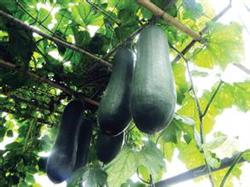 Summer wax gourd is generally sown in June-July and transplanted in August-September. Because its growth occurs in the high-temperature and high-humidity season, the contradiction between fertilizer and water supply and growth and development is intensified. In particular, whether or not to prune is the key to affecting the commercial yield of wax gourd. To achieve a yield of more than 4000 kg per mu, the cultivation key points are as follows:
1. Transplanting at the proper seedling age: when wax gourd seedlings reach 30 days of age and grow to the two-true-leaf-one-bud stage, select seedlings with well-developed roots, thick stems with short internodes, thick and dark green leaves, and no damage for transplanting. Generally, when only the main vine is retained, plant 800-900 plants per mu; when two vines are retained, plant 400-500 plants per mu.
2. Reasonable topdressing: after the seedlings survive transplanting, apply 1000 kg of 20% human feces and urine; when the fruit grows to 4-5 kg, apply 4-5 kg of human feces and urine or 0.1 kg of urea in holes; when the fruit grows to 15-20 kg, apply 5-6 kg of human feces and urine or 0.2 kg of urea in holes. Afterwards, if the seedling color is pale, apply another 2-3 kg of human feces and urine per hill.
3. Pruning: pruning is an effective measure to increase yield, control excessive vegetative growth, and ensure uniform fruit size. Generally, when only the main vine is retained for cultivation, retain fruit after about 24 leaves have developed or after the second female flower opens, leaving 2-3 fruits per plant. After the second or third fruit is set, leave 4-5 leaves after the fruit, remove the terminal bud, strip off old leaves, and cut off side branches and axillary buds; when the main and secondary vines are retained for cultivation, the fruit-setting position on the main vine is the same as above, and fruit is retained when the secondary vine has about 20 leaves, with other requirements the same as above. Due to differences in environmental conditions, the position and number of retained fruits may vary, but pruning and fruit padding are necessary, and upright fruit padding is preferable.
4. Disease and pest control: the diseases and pests occurring on wax gourd include damping-off, fusarium wilt, phytophthora blight, aphids, and white grubs. For damping-off control, use 75% chlorothalonil 1000-fold solution or 20% dexon 1000-fold solution; for fusarium wilt control, use 50% carbendazim 500-fold solution or 20% tolclofos-methyl EC 900-fold solution; for phytophthora blight control, spray or drench the roots with 50% carbendazim or 50% metalaxyl-copper 600-fold solution, applying 0.3-0.5 L per plant, once about every 10 days, with good results after 2-3 consecutive applications. For aphid control, use dimethoate 800-fold solution or trichlorfon 1000-fold solution; for white grub control, drench the roots with 50% phoxim 1000-fold solution or 90% crystalline trichlorfon 1000-fold solution.
5. Harvesting: when the fuzz on the fruit surface gradually fades and white powder appears near the fruit stalk, harvesting can begin successively. If market conditions are good, young fruits can be marketed to improve economic returns.